ALMOST 70% BUILT
Want to back the stream? The «داعم» membership on YouTube is EGP 60 a month: badges, emoji, and I answer your questions first on stream. Become a supporter
The gist
The stream documents the practical development of Burnish, a product beginning on Shopify and exploring how stores can improve their visibility in AI answers and platforms through GEO. Much of the work centers on the website and product message: clarifying the problem, solution, and customer outcome; structuring the homepage and pricing page; routing “Scan My Store” calls to action consistently; and refining cards, contrast, mobile layouts, scroll interactions, and a floating 3D logo. Visual reviews repeatedly led to revisions or removal of immersive effects when they distracted from the product, alongside recognition that excessive polish could delay shipping. The pricing experience advanced, but the homepage and especially the scan flow still required substantial frontend and backend work. The proposed scan collects a native Shopify store address and business email, then leads toward a deeper AI-visibility report. Important questions remained unresolved, including audit cost, the instant result or teaser, brand-name detection, usage limits, protection of shared public infrastructure, report-email delivery, and the terms of a refundable reservation. The discussion emphasized honest scarcity indicators and responsible marketing claims. Lighthouse and browser inspection provided preliminary performance signals, but measurements from an older site were not treated as final evidence for the heavier new version; screenshot and animation problems also remained under investigation. For implementation, Luqman compares Claude and Codex and assigns design, backend, migration, and audit work according to their perceived strengths. The workflow uses separated specifications, milestones, dependencies, a Command Center, coding agents, audits, and human visual review. His practical conclusion is that specific instructions, clean context handoffs, and deliberate sequential work are often more manageable than too many simultaneous sessions. The stream does not establish that every migration, audit, or automated workflow was completed successfully. The broader discussion turns to go-to-market work: validating demand before launch, building a list and organic distribution, warming an email domain, and testing advertising or direct sales in phases. Luqman argues that market response—not personal enthusiasm—is the real test of an idea, and that a strong product still needs marketing and distribution. He presents GEO and AEO as emerging relatives of SEO; based on his reading of trends, he observed growing interest during 2025 and predicted further growth by September 2026, explicitly as an opinion rather than confirmed market evidence. Audience questions also cover whether non-developers can build with AI, learning by doing, Micro-SaaS and B2B opportunities, model and hosting choices, and choosing Telegram or Discord for an Arabic-speaking community. Overall, this is an unfinished build-and-validation journey rather than a completed launch, with product viability and growth channels still awaiting real market evidence.
163 moments from the stream
- 7:19:08
Discussing Hosting Alternatives to Vercel
The speaker discussed Cloudflare and Railway as possible alternatives to Vercel, describing Cloudflare as suitable for websites and Railway as potentially useful for applications. He also expressed a personal objection to Vercel based on an older remark whose context he could not recall precisely, while acknowledging the platform’s strong technical standing.
- 7:23:47
Coordinating Automated Coding Tasks Through a Command Center
The speaker showed a command center coordinating parallel milestones across coding agents and moving tasks through workflow states. He referred to dozens of automated tasks, while some state labels and agent names remained unclear in the captions.
- 7:25:20
Reviewing the Quality of a New Landing Page
The speaker reviewed a new landing-page version after removing an element he considered unnecessary. He then identified implementation and verification problems, including a cropped header, and began pointing out areas needing correction.
- 7:27:24
Improving Visual Hierarchy and AI Engine Presentation
A design review recommends keeping the header within the viewport, addressing unexplained empty space, reconsidering the section background, and presenting six AI-engine logos more thoughtfully than a simple list of names. It also calls for a more prominent CTA and considers a background effect or AI-generated video as creative options rather than confirmed decisions.
- 7:31:19
Why Flashy Design Can Distract from a Software Product
The discussion argues that immersive effects can look attractive while overemphasizing web-development flair and distracting customers from a software company's message. A simpler treatment consistent with the surrounding sections was therefore preferred, while acknowledging that the removed experience could have been refined but felt somewhat gimmicky and would require more time.
- 7:32:56
Checking Pricing References Before Task Approval
While inspecting an unfinished dashboard, the speaker asks for the latest pricing changes to be checked against the website landing page and an internal documentation source, with appropriate research before adjusting tasks and approving items in review. Several field names and details are unclear in the captions and are therefore left uninterpreted.
- 7:38:08
A Clear Vision as Motivation for Work
Drawing on personal experience, the speaker argues that a specific, tangible vision reduces the need for self-motivation and strengthens commitment. He suggests extended self-reflection on weaknesses, goals, and what one truly wants to build.
- 7:42:38
Building a Strong Community Around a Specialized Product
The speaker discusses how a founder can build a supportive community from scratch even when the product does not suit every user. He suggests the app may particularly appeal to people who favor development environments with multiple terminals, while separating product criticism from respect for the founder’s effort and vision.
- 7:44:15
Fixing the Playwright MCP Screenshot Workflow
The speaker pauses the broader work to address a Playwright MCP problem that was interfering with screenshots and causing extra review cycles, asking for the setup to be checked and for multiple sub-agents to help prepare the work.
- 7:45:44
Creating Meta Campaigns Through Coding Agents
The speaker discusses the significance of a Meta MCP for advertising management, which could allow campaigns and ads to be created through coding agents and code instead of manually entering the ad-management platform. He says he could not find the tool and that it appeared not to have been released yet, so this remains a discussion of an expected capability rather than a completed test.
- 7:46:59
Bringing Measurement Tools Into a Command Center
The speaker outlines a plan to add a tracking pixel and tools such as Google Analytics, PostHog, Google Search Console, and Google Tag Manager, with their management incorporated into the command center through programmatic integrations.
- 7:47:32
A Central Analytics Dashboard Without Sacrificing Quality
A plan to connect Google Analytics, Search Console, and email conversion data in one central dashboard. As the workload became clearer, the speaker chose not to impose a deadline so the application could be brought to market at a good standard.
- 7:52:03
Coordinating Multiple Agents and Reviewing a Page UI
Practical work using multiple agents on tasks in a project board, followed by a visual homepage review. Feedback addresses a clipped header, the subheading and logos, and MP4 placement, with a server restart considered when the expected result did not appear.
- 8:00:20
A SaaS Opportunity Around Go-to-Market
The speaker argues that go-to-market SaaS could solve a real problem for builders who can create products but do not know how to market them, and notes visible interest in this area. He also distinguishes the idea from micro-SaaS.
- 8:03:03
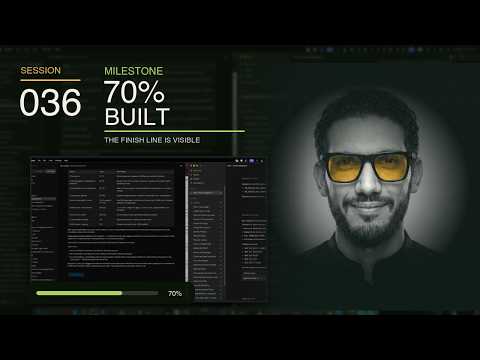
Why Project Completion Estimates Can Fall During Progress
The speaker explains that an estimated completion percentage can fall even while work continues when review uncovers essential tasks, such as a UI component migration and other substantial additions to the task board. The expanding necessary scope makes the estimate more realistic; it does not erase prior work.
- 8:03:49
Learn Marketing, Not Only Vibe Coding
In the speaker's view, AI has made it easier to build an attractive website, but go-to-market remains a broad challenge rather than a merely local one. AI can assist with coding and marketing, but it does not automatically sell the product, so he recommends prioritizing marketing knowledge while learning vibe coding through practice.
- 8:05:13
Simplifying Landing-Page Changes After Review
A practical review that freezes acceptable sections instead of continuing to revise them and focuses attention on the more difficult landing page. The resulting direction is to remove two newly added videos while temporarily keeping the muted grid background.
- 8:08:23
SaaS Operating Costs, Margins, and Organic Growth
A brief view that falling SaaS operating costs can improve gross margins and allow some providers to lower prices, alongside an emphasis on attracting traffic organically.
- 8:09:21
Connecting Shopify App Dev to an Existing App
During Shopify development setup, the tool asked whether to create a new app or connect to an existing one, and the existing-app path was selected.
- 8:11:10
Troubleshooting an Old Pricing Plan Still Appearing
The old pricing plan was still appearing despite following the requested steps, prompting an initial check of terminal output and a possible configuration key; the captions do not document a final resolution.
Got a question about something in this stream?
Ask in the group