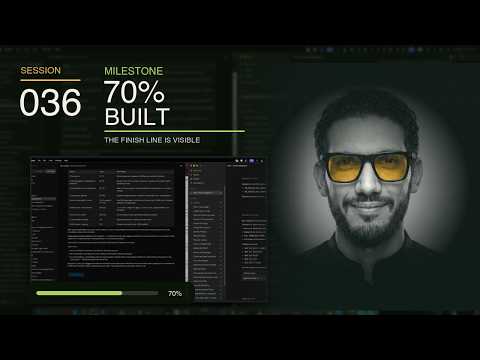
ALMOST 70% BUILT
Want to back the stream? The «داعم» membership on YouTube is EGP 60 a month: badges, emoji, and I answer your questions first on stream. Become a supporter
The gist
The stream documents the practical development of Burnish, a product beginning on Shopify and exploring how stores can improve their visibility in AI answers and platforms through GEO. Much of the work centers on the website and product message: clarifying the problem, solution, and customer outcome; structuring the homepage and pricing page; routing “Scan My Store” calls to action consistently; and refining cards, contrast, mobile layouts, scroll interactions, and a floating 3D logo. Visual reviews repeatedly led to revisions or removal of immersive effects when they distracted from the product, alongside recognition that excessive polish could delay shipping. The pricing experience advanced, but the homepage and especially the scan flow still required substantial frontend and backend work. The proposed scan collects a native Shopify store address and business email, then leads toward a deeper AI-visibility report. Important questions remained unresolved, including audit cost, the instant result or teaser, brand-name detection, usage limits, protection of shared public infrastructure, report-email delivery, and the terms of a refundable reservation. The discussion emphasized honest scarcity indicators and responsible marketing claims. Lighthouse and browser inspection provided preliminary performance signals, but measurements from an older site were not treated as final evidence for the heavier new version; screenshot and animation problems also remained under investigation. For implementation, Luqman compares Claude and Codex and assigns design, backend, migration, and audit work according to their perceived strengths. The workflow uses separated specifications, milestones, dependencies, a Command Center, coding agents, audits, and human visual review. His practical conclusion is that specific instructions, clean context handoffs, and deliberate sequential work are often more manageable than too many simultaneous sessions. The stream does not establish that every migration, audit, or automated workflow was completed successfully. The broader discussion turns to go-to-market work: validating demand before launch, building a list and organic distribution, warming an email domain, and testing advertising or direct sales in phases. Luqman argues that market response—not personal enthusiasm—is the real test of an idea, and that a strong product still needs marketing and distribution. He presents GEO and AEO as emerging relatives of SEO; based on his reading of trends, he observed growing interest during 2025 and predicted further growth by September 2026, explicitly as an opinion rather than confirmed market evidence. Audience questions also cover whether non-developers can build with AI, learning by doing, Micro-SaaS and B2B opportunities, model and hosting choices, and choosing Telegram or Discord for an Arabic-speaking community. Overall, this is an unfinished build-and-validation journey rather than a completed launch, with product viability and growth channels still awaiting real market evidence.
163 moments from the stream
- 8:12:32
Testing Image Generation from a Prompt
An image-generation experiment was started from a prompt and the output was then inspected; the tool name and some settings are unclear in the captions, and no reliable assessment of the result is recorded.
- 8:20:29
GEO and AEO as an Emerging Path for Shopify Visibility in AI Answers
The speaker describes an app concept for helping Shopify merchants improve their visibility on AI platforms through Generative Engine Optimization (GEO), comparing it with AEO and traditional SEO. In his reading of Google Trends, interest in the newer terms began emerging around mid-to-September 2025; as an opinion rather than a confirmed outcome, he predicts stronger growth by September 2026. He recommends learning the field early even without immediately building a product, while an audience comment linked its importance to potential future in-conversation purchasing.
- 8:26:29
Choosing Telegram or Discord for an Arabic-Speaking Community
The speaker prefers Discord, describing it as more comfortable and better, but believes it is less widely used outside gaming communities in Egypt and the Arab world, so he chose Telegram to better reach his audience. He leaves a future move to Discord open if the community grows and its members agree.
Got a question about something in this stream?
Ask in the group