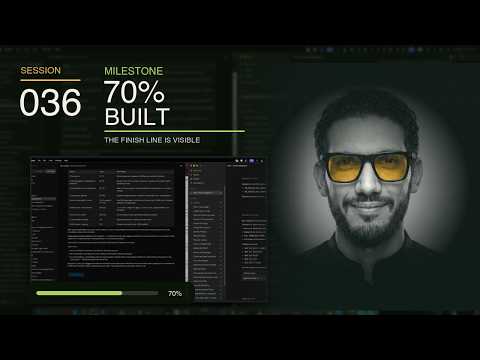
ALMOST 70% BUILT
Want to back the stream? The «داعم» membership on YouTube is EGP 60 a month: badges, emoji, and I answer your questions first on stream. Become a supporter
The gist
The stream documents the practical development of Burnish, a product beginning on Shopify and exploring how stores can improve their visibility in AI answers and platforms through GEO. Much of the work centers on the website and product message: clarifying the problem, solution, and customer outcome; structuring the homepage and pricing page; routing “Scan My Store” calls to action consistently; and refining cards, contrast, mobile layouts, scroll interactions, and a floating 3D logo. Visual reviews repeatedly led to revisions or removal of immersive effects when they distracted from the product, alongside recognition that excessive polish could delay shipping. The pricing experience advanced, but the homepage and especially the scan flow still required substantial frontend and backend work. The proposed scan collects a native Shopify store address and business email, then leads toward a deeper AI-visibility report. Important questions remained unresolved, including audit cost, the instant result or teaser, brand-name detection, usage limits, protection of shared public infrastructure, report-email delivery, and the terms of a refundable reservation. The discussion emphasized honest scarcity indicators and responsible marketing claims. Lighthouse and browser inspection provided preliminary performance signals, but measurements from an older site were not treated as final evidence for the heavier new version; screenshot and animation problems also remained under investigation. For implementation, Luqman compares Claude and Codex and assigns design, backend, migration, and audit work according to their perceived strengths. The workflow uses separated specifications, milestones, dependencies, a Command Center, coding agents, audits, and human visual review. His practical conclusion is that specific instructions, clean context handoffs, and deliberate sequential work are often more manageable than too many simultaneous sessions. The stream does not establish that every migration, audit, or automated workflow was completed successfully. The broader discussion turns to go-to-market work: validating demand before launch, building a list and organic distribution, warming an email domain, and testing advertising or direct sales in phases. Luqman argues that market response—not personal enthusiasm—is the real test of an idea, and that a strong product still needs marketing and distribution. He presents GEO and AEO as emerging relatives of SEO; based on his reading of trends, he observed growing interest during 2025 and predicted further growth by September 2026, explicitly as an opinion rather than confirmed market evidence. Audience questions also cover whether non-developers can build with AI, learning by doing, Micro-SaaS and B2B opportunities, model and hosting choices, and choosing Telegram or Discord for an Arabic-speaking community. Overall, this is an unfinished build-and-validation journey rather than a completed launch, with product viability and growth channels still awaiting real market evidence.
163 moments from the stream
- 2:47:28
Browser Inspection and Screenshot Limitations
The speaker discusses opening and inspecting the site through browser integrations, mentioning Playwright MCP and Codex. He reports an undiagnosed screenshot problem and explicitly remains unsure about the mechanism Codex uses to access the browser.
- 2:49:10
When High Standards Delay Website Completion
The speaker reflects that although he prefers simple websites, he may be over-polishing this one instead of finishing it. He suggests this could come from hesitation about taking the next step or from a gap between his high visual standards and current web-development ability, while noting that he is largely pleased with the result despite the time and effort involved.
- 2:52:59
Preventing Users from Skipping a Card Too Quickly
A block after a card finishes loading was proposed to prevent users from scrolling away from it too quickly, because the goal is to provide them with information.
- 2:55:52
Redesigning Four Cards with Visual Consistency
The cards were to be changed from a horizontal layout to a vertical or square format, with the design direction understood first and then applied consistently across all four cards, using multiple subagents and an implementation plan if needed.
- 2:58:11
Describing a Background by Appearance, Not the Wrong Color Name
Elements beneath the input bar were to be adjusted to work with the background. The discussion stressed avoiding an inaccurate label such as “black” when the background is not actually black, since that could misdirect the design.
- 2:59:04
Reviewing the Pricing and Scan Pages
The pricing page was treated as largely complete, with its hero section left for possible later improvement. The scan page was described as the most important page but still unfinished because it also depends on backend work that could take several days.
- 3:00:28
Two Connected Flows for the Store-Scan Experience
“Scan My Store” was framed as two connected flows: an initial scan from a public URL that guides the user toward the next step, and a deeper loop involving app installation, catalog scanning, index calculation, identifying gaps, addressing issues, and preparing a report. The form was described only as a lead-capture path, and the important follow-up work was to continue with Claude.
- 3:01:51
The Goal of “Scan My Store”
A discussion of closing a key gap on the Burnish website: creating a seamless front-end flow that captures an email address and store URL before the store analysis.
- 3:03:20
Using On-Page Annotations for UI Feedback
An explanation of using on-page annotations to identify a specific interface area and describe the requested change, mainly for lightweight feedback or when the context is unclear.
- 3:04:25
Codex Proactively Invoking an Installed Skill
An observation that Codex inferred an installed skill was relevant from the back-and-forth discussion and invoked it without an explicit request by name; the skill name and some following output are unclear in the captions.
- 3:07:10
Reshaping Cards for a More Mobile-Friendly Layout
A review of a difficult interface section concludes that the horizontal card feels too stretched, favoring a more compact design that may work better on mobile.
- 3:08:54
Balancing an Instant Teaser with Audit Cost
A discussion of the fast result shown after email submission, noting that a broader AI-visibility audit has a cost that must be understood. The tentative direction was to combine a main view with a secondary teaser, while some metric names and details remain unclear.
- 3:13:20
New Public Routes and Shared-Infrastructure Risk
New public endpoints in Burnish were described as reusing existing components alongside merchant routes, with a warning that the public abuse surface shares infrastructure with merchant data.
- 3:14:23
A Phased Go-to-Market and Validation Plan
Answering a launch question, Luqman outlined a phased go-to-market approach built around acquisition funnels and outbound sales, with limited ads for market validation and later scaling only if returns justify it. He emphasized that marketing is among the hardest parts of building a business and expected to shift more attention from coding toward deeper marketing work.
- 3:17:33
Building Without Prior Web Experience and Sharing Proven Workflows
Luqman encouraged a viewer to try building an English-learning website, noting from his own experience that lacking a web-development background need not prevent someone from starting. He also said he prefers not to share a go-to-market workflow until it has produced evidence of real results.
- 3:18:41
Choosing Ad Channels for Validation and Scaling
Luqman distinguished using social-media ads for initial market validation from possible channels for later scaling. He mentioned Google Ads as a candidate while qualifying that it is expensive and that no final decision had been made.
- 3:21:37
Designing Inputs for a Shopify Store-Scan Report
The discussion treated the “Scan My Store” call to action as a core website feature: accept the store’s native Shopify domain rather than any general URL, request a business email, and return a deep, high-quality report. It also raised the conversion impact of stricter inputs and the backend engineering needed to produce that report.
- 3:27:12
Opinions on Targeting Shopify Merchants Across the Funnel
Luqman discussed B2B channels for reaching Shopify merchants, arguing that LinkedIn and Meta offer useful targeting while Google keyword campaigns may reach higher-intent users at greater cost. He proposed Meta for validation and top-of-funnel activity, more intent-focused advertising lower in the funnel, and retargeting website visitors, presenting this as his current view rather than a confirmed test result.
- 3:30:29
Preventing Abuse of a Store-Scanning Tool
The work considered per-IP and per-store usage limits. Luqman questioned the realistic abuse scenarios because a store’s native Shopify domain is less obvious than its public website URL, asking which risks rate limiting actually needs to address.
- 3:32:27
Working seriously and avoiding the comfort zone
The speaker argues that productive, sustained effort is important for achieving results and warns that working from home can become a comfort zone that undermines serious work.
Got a question about something in this stream?
Ask in the group