Astra Managing Two Claude Accounts
Want to back the stream? The «داعم» membership on YouTube is EGP 60 a month: badges, emoji, and I answer your questions first on stream. Become a supporter
The gist
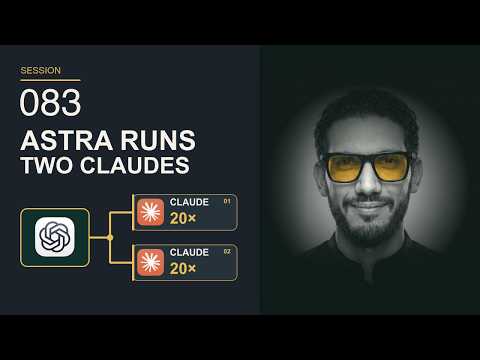
This indexed portion focuses on Luqman’s account of coordinating Claude sessions through Astra and Codex using requirements documents, roadmaps, periodic follow-ups, and draft prompts. He sees this as movement toward greater automation while retaining human direction. Tracking parallel work through Mission Control remains a recurring problem; the records do not confirm its repair or completion of project milestones. He also explores a workspace that adapts to user goals, outcome-based token estimates, and voice interaction, with feasibility, costs, and delivery timelines unresolved. Audience questions cover model selection, usage limits, assistant agreeableness versus forced criticism, and whether QA can keep pace with AI-assisted development. Luqman suggests AI-assisted testing under human supervision without presenting a practical evaluation. Other discussions emphasize marketing, distribution, and sufficient traffic to assess product performance, alongside his view of intense Shopify competition. Beginner guidance focuses on discussing goals with an assistant, learning through building, and sharing work publicly. Luqman also discusses his expectations for AI pricing and broader access at different price levels, including potentially improved efficiency and lower prices following IPOs. He speculates about model launches and IPO timing, including his recording-time prediction of a possible OpenAI IPO in Q1 or Q2 2027. He also imagines AI companies expanding into dedicated assistant hardware, such as necklaces and pocket devices; these are forecasts rather than confirmed policies or events. Creative work includes directing noir-jazz and Eastern-influenced focus music through Suno Studio, reviewing character movement and seamless visual loops, and exploring a hoopoe mascot and a bounded website explainer. Advertising interruptions, stream quality, and encoding load also receive attention. This portion combines explanations, exploration, and revision requests, with several work outcomes remaining unconfirmed.
165 moments from the stream
- 5:35:34
Planning an API trial and estimating consumption
A request for an implementation plan to try the proposed setup firsthand and understand its API consumption rate. The trial is proposed; no results are shown here.
- 5:37:00
Are bugs in AI-built apps a barrier?
Luqman responds to a question about bugs in AI-built apps and the knowledge needed to fix them. He encourages continued building and repeats a prediction that software's value will reach zero as building becomes widely accessible; this is a forecast, not a test result.
- 5:38:31
Suggestion to enable reused-video detection
The discussion suggests enabling a feature that detects others reusing a video. Luqman agrees to enable it but is unsure whether it is already active; the platform is not clearly identified.
- 5:40:09
Planning a bird's entrance in a window scene
After reporting that the work nearly disrupted the stream, Luqman asks to defer execution and describes adding a bird before a woman at a window or balcony, as though speaking to her before flying away. He considers extending the scene beyond twenty seconds or introducing the bird at the start to reduce rework; the captions show no implementation result.
- 5:44:36
AI in cyberattacks and cyber defense
Luqman argues that the prospect of increasing AI-assisted attacks is a reason to use AI for defense and security improvement as well. This is a general position, with no specific tools or security tests demonstrated in the captions.
- 5:45:59
Views on AI capabilities and cybersecurity
Luqman argues that AI makes cyberattacks more sophisticated and advises against dwelling on dismissive views of its security and website-building capabilities, which he considers shortsighted.
- 5:50:04
Automatic prompt delegation through Astra
Luqman describes Astra distributing a prompt without an additional instruction, interpreting this as continued awareness of the work context.
- 5:51:16
MiniMax question and possible Chinese-model harnessing
Luqman says he has not personally tried MiniMax. If he continues the work under discussion, he expects to explore Chinese models and build harnesses around them.
- 5:52:22
Why Luqman prefers Astra for orchestration and computer use
Luqman argues that delegation and orchestration require strong computer use. He prefers Astra in this context, describing its separate pointer as an advantage over Claude controlling the user's mouse.
- 5:54:55
A positive impression of premium ginger ale
Luqman expresses enthusiasm for a premium ginger ale; the brand name is unclear in the captions.
- 5:56:41
Opinion on a carbonated ginger drink
The speaker describes a carbonated ginger drink and says he likes it. The product name is unclear.
- 5:57:13
Question about split-screen support
Asked about split-screen support, the speaker says the tool lacks it at the time of the discussion and finds that frustrating. The tool's name is unclear in the captions.
- 5:59:34
Waiting for a draft prompt during handoff
The speaker describes becoming accustomed to a draft prompt associated with handoff and notes that he is waiting for it to appear, but it has not appeared at that moment.
- 6:04:40
Reviewing head-movement naturalness
While reviewing work, the speaker considers the overall quality acceptable but criticizes repeated head movements as unnatural and insufficiently relaxed. He wants more natural motion without excessive stillness; the reviewed subject is unclear.
- 6:07:10
Tracking progress across parallel work
Luqman and the audience discuss how background work and effort spread across multiple projects can make progress difficult to perceive. He mentions using a roadmap to make that progress clearer.
- 6:08:35
From manual session prompting to self-prompting
Luqman describes his workflow shifting from prompting each session and reviewing files with it toward greater automation and self-prompting. Comparing it with another CLI-based workflow, he doubts that those tools offer self-prompting at the time of the discussion.
- 6:12:40
Familiarity with Arabic and English technical terms
A light discussion of Arabic technical vocabulary, including terms for automation and technology. Luqman explains that routinely using English equivalents at work makes some Arabic terms less familiar to him.
- 6:16:10
Microphone permission and voice assistant responses
The speaker explains that the microphone operates with user permission and sends the question to OpenAI for interpretation, while the assistant uses prerecorded synthetic-voice responses.
- 6:21:38
Automation and waiting for results
In a brief opinion, the speaker describes automated work as potentially boring, with the user spending tokens and waiting for results.
- 6:22:17
Tongue twisters and the need for Arabic diacritics
The speaker tries audience-suggested Arabic tongue twisters and discusses how unfamiliar words can require diacritics or clearer wording to understand and pronounce.
Got a question about something in this stream?
Ask in the group