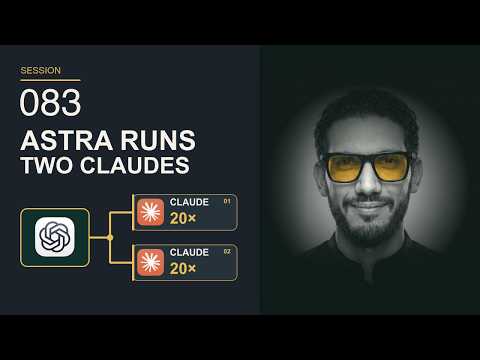
Astra Managing Two Claude Accounts
Want to back the stream? The «داعم» membership on YouTube is EGP 60 a month: badges, emoji, and I answer your questions first on stream. Become a supporter
The gist
This indexed portion focuses on Luqman’s account of coordinating Claude sessions through Astra and Codex using requirements documents, roadmaps, periodic follow-ups, and draft prompts. He sees this as movement toward greater automation while retaining human direction. Tracking parallel work through Mission Control remains a recurring problem; the records do not confirm its repair or completion of project milestones. He also explores a workspace that adapts to user goals, outcome-based token estimates, and voice interaction, with feasibility, costs, and delivery timelines unresolved. Audience questions cover model selection, usage limits, assistant agreeableness versus forced criticism, and whether QA can keep pace with AI-assisted development. Luqman suggests AI-assisted testing under human supervision without presenting a practical evaluation. Other discussions emphasize marketing, distribution, and sufficient traffic to assess product performance, alongside his view of intense Shopify competition. Beginner guidance focuses on discussing goals with an assistant, learning through building, and sharing work publicly. Luqman also discusses his expectations for AI pricing and broader access at different price levels, including potentially improved efficiency and lower prices following IPOs. He speculates about model launches and IPO timing, including his recording-time prediction of a possible OpenAI IPO in Q1 or Q2 2027. He also imagines AI companies expanding into dedicated assistant hardware, such as necklaces and pocket devices; these are forecasts rather than confirmed policies or events. Creative work includes directing noir-jazz and Eastern-influenced focus music through Suno Studio, reviewing character movement and seamless visual loops, and exploring a hoopoe mascot and a bounded website explainer. Advertising interruptions, stream quality, and encoding load also receive attention. This portion combines explanations, exploration, and revision requests, with several work outcomes remaining unconfirmed.
165 moments from the stream
- 4:16:13
Periodic session coordination versus hooks
The speaker prefers exchanging updates every fifteen minutes until tasks are complete, arguing that hooks could generate excessive communication.
- 4:17:15
Expected returns from email versus advertising
The speaker expects email outreach to outperform advertising, but presents no comparative results.
- 4:17:35
Background music blending noir jazz and Eastern influences
Responding to a question about the background music, the speaker describes a blend of noir jazz, Eastern influences, and oud.
- 4:20:08
Estimating the cost of an hourly service
A worked estimate multiplies the hourly rate by daily usage and the number of days, assuming one hour per day for thirty days.
- 4:21:37
Should live work streams separate content by skill level?
A viewer suggests defining the audience and separating content by skill level to reduce confusion. The speaker explains that the stream shares work across levels, adapting explanations and offering clarification.
- 4:22:48
Using Codex to manage multiple Claude sessions
The speaker describes using Codex's computer-use capabilities to open Claude sessions, distribute tasks, communicate with them, and review code. Session concurrency is adjusted according to tasks, speed, and token efficiency.
- 4:25:57
Building in public and sharing work
Luqman describes his approach to sharing work as building in public, an idea he adopted rather than invented. In his view, it is less well known in the Arab world and has grown more popular with the emergence of AI tools.
- 4:26:59
Where to start with Codex or Claude
For someone unsure where to begin, Luqman suggests installing Codex or Claude and discussing their background, ambitions, and desired specialization to explore whether the tool can help with their goals.
- 4:36:20
A bounded website explainer
Luqman proposes letting visitors speak with a hoopoe character to learn about the project and its intended benefits, while estimating and controlling usage costs. He later narrows the interaction to a brief explanation, possibly allowing one follow-up question.
- 4:37:57
Using AI to pursue a specific goal
Luqman recommends giving an assistant context about a person's interests, then choosing a goal and following progress toward it. He gives examples involving study, work, and habit change, and advocates tools with a minimal learning curve.
- 4:39:46
Running Claude sessions through Codex
Luqman describes a workflow in which Codex activates Claude sessions and expresses satisfaction with using Astra alongside Claude. He explains his growing preference for automation and his view that it requires capable tools.
- 4:41:31
Questioning AI-generated delivery estimates
Luqman criticizes AI-generated timelines and describes Claude's estimates as unreliable in his experience. He discusses whether they assume a human programmer's pace rather than continuously running AI sessions, and reports that challenging this assumption led to the estimate being withdrawn without a replacement.
- 4:42:22
A hoopoe brand mascot and separate agent designs
Luqman considers a custom hoopoe as the brand mascot. He proposes handling subagent classification and visual design separately, without requiring every agent to take a bird form.
- 4:45:28
Supervising multiple coding sessions with Astra
Luqman describes using Astra to supervise several coding sessions, track tasks and milestones, and sometimes review code.
- 4:47:20
Automation and using your own development environment
He explains his preference for greater automation and argues that a development environment he builds should outperform his current workflow before he adopts it himself. He connects this to developers using their own products before expecting others to adopt them.
- 4:49:57
Do peak hours still affect Claude?
A question asks whether Claude still has peak hours. Luqman initially thinks they were removed, tentatively recalling Ramadan or April without specifying a year. An audience comment suggests they remain, leaving the question unresolved.
- 4:51:23
Traffic as a prerequisite for evaluating product metrics
The discussion explains why sufficient daily traffic is needed to evaluate metrics such as installs, conversion to paid use, and drop-off. Limited visibility restricts the ability to interpret product performance.
- 4:53:33
Tracing a competitor from an apparent rename to an acquisition
Luqman recounts searching for a Shopify competitor, initially interpreting its changed identity as a rebrand, then understanding it as an acquisition by another company. The account is his report, without independent verification in this passage.
- 4:54:24
Product quality needs visibility and distribution
Luqman argues that product quality matters but cannot generate sales without an audience, and that occasional visits may be insufficient. He describes finding a source of traffic as a difficult challenge.
- 4:55:49
Using Claude Code inside Cursor
An audience member praises using Claude Code inside Cursor compared with Claude desktop. Luqman asks what improves in practice and raises potentially faster allowance consumption; the discussion establishes no definitive comparison.
Got a question about something in this stream?
Ask in the group