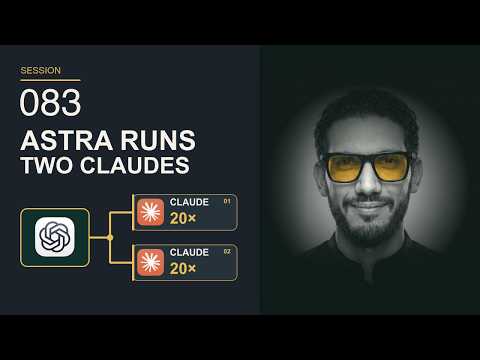
Astra Managing Two Claude Accounts
Want to back the stream? The «داعم» membership on YouTube is EGP 60 a month: badges, emoji, and I answer your questions first on stream. Become a supporter
The gist
This indexed portion focuses on Luqman’s account of coordinating Claude sessions through Astra and Codex using requirements documents, roadmaps, periodic follow-ups, and draft prompts. He sees this as movement toward greater automation while retaining human direction. Tracking parallel work through Mission Control remains a recurring problem; the records do not confirm its repair or completion of project milestones. He also explores a workspace that adapts to user goals, outcome-based token estimates, and voice interaction, with feasibility, costs, and delivery timelines unresolved. Audience questions cover model selection, usage limits, assistant agreeableness versus forced criticism, and whether QA can keep pace with AI-assisted development. Luqman suggests AI-assisted testing under human supervision without presenting a practical evaluation. Other discussions emphasize marketing, distribution, and sufficient traffic to assess product performance, alongside his view of intense Shopify competition. Beginner guidance focuses on discussing goals with an assistant, learning through building, and sharing work publicly. Luqman also discusses his expectations for AI pricing and broader access at different price levels, including potentially improved efficiency and lower prices following IPOs. He speculates about model launches and IPO timing, including his recording-time prediction of a possible OpenAI IPO in Q1 or Q2 2027. He also imagines AI companies expanding into dedicated assistant hardware, such as necklaces and pocket devices; these are forecasts rather than confirmed policies or events. Creative work includes directing noir-jazz and Eastern-influenced focus music through Suno Studio, reviewing character movement and seamless visual loops, and exploring a hoopoe mascot and a bounded website explainer. Advertising interruptions, stream quality, and encoding load also receive attention. This portion combines explanations, exploration, and revision requests, with several work outcomes remaining unconfirmed.
165 moments from the stream
- 0:51:41
Agent characters: the hoopoe and customization
Luqman discusses visual characters for subagents. A participant suggests allowing alternatives such as planets; Luqman clarifies that birds are optional while expressing a preference for addressing a hoopoe character. The concept remains under consideration.
- 0:53:08
Planning looping motion for an image
Luqman requests an idea for looping motion based on an image, preserving its visual mood and making the character's clothing more modest.
- 0:53:44
Periodic session supervision with Astra
Luqman points out sessions becoming active again and explains that scheduled follow-ups every fifteen minutes review the work and continue prompting. He later identifies Astra as supervising active sessions.
- 1:02:05
Reviewing product vision and preparing agent work
Luqman asks for a review of the roadmap and completed work to develop a product vision. He argues that preparing a work system upfront helps an AI agent explore details and produce better work.
- 1:03:17
Building games with AI assistance
Luqman discusses building a game from scratch with AI assistance, citing an anecdote about a Steam game made through vibe coding. The discussion does not verify the example.
- 1:09:09
Assessing competition on Shopify
Luqman describes competition on Shopify as much fiercer than expected, in a discussion about assessing competition when planning a product.
- 1:09:59
From product documents to milestones and tasks
Answering an audience question, Luqman explains deriving a roadmap from product requirements and a manifesto, then dividing it into milestones, missions, and tasks. He emphasizes that the agent needs a clear understanding of the vision and goal to organize the work.
- 1:11:16
Providing context before delegating work
The speaker considers sufficient context and appropriate technical background especially important when an assistant distributes work into tasks and manages multiple sessions.
- 1:15:58
Does polishing slow down an MVP?
An audience comment suggests that polishing details may slow MVP development. The speaker considers that possibility, describes organizing work into milestones and tasks, and argues that model usage limits constrain further speed.
- 1:18:43
Reviewing character movement and a mirror reflection
The comments suggest giving a seemingly still character a simple action, such as drinking, followed by a preference to leave the scene without additions. Audience discussion also draws attention to movement and a mirror reflection.
- 1:20:11
Blending noir jazz with Middle Eastern instruments
The speaker describes a calmer musical direction blending noir jazz with Middle Eastern instruments, including oud and ney, and contrasts it with dub techno.
- 1:21:42
Suggestions for learning English
Luqman suggests using Duolingo and says immersion in an English-speaking environment can accelerate learning.
- 1:22:03
Finding a standing desk
Answering a desk question, Luqman suggests searching for “standing desk” without identifying a brand.
- 1:25:25
Coordinating four Claude sessions with Astra and Codex
Luqman says Astra launched four Claude sessions and Codex manages and follows up with them. He describes this as an early step toward full autonomy with light human guidance, and sees substantial workflow improvement compared with March and April, without specifying a year.
- 1:27:15
Claude and Codex as a foundation alongside supporting tools
Asked whether additional tools are needed, Luqman presents Claude and Codex as a broadly capable foundation while acknowledging that other tools can simplify particular tasks. This is his personal assessment rather than a tested comparison.
- 1:29:04
Attracting traffic and visibility for a Shopify app
Discussing an app that helps Shopify merchants appear on AI platforms, Luqman identifies limited visibility, traffic, and strong competition as marketing challenges in his view. Approaches include trying an email campaign before expanding it, alongside ongoing posting and blogging; this discussion provides no results for the proposed campaign.
- 1:33:22
Guiding Suno with melodies and musical modes
Describes preparing melodies in a mode such as Hijaz using Python with Claude, then supplying them to Suno to guide generation. Also mentions layering music in Suno Studio; these are workflow suggestions, without a demonstrated test in this passage.
- 1:34:16
Varying a character’s idle movements
Requests idle movements including playing with the character’s hair and occasionally looking right. Three movements are proposed overall, with the third still undecided.
- 1:36:55
Making Claude session progress visible with Astra
Requests an overview of the first milestone’s purpose and progress because the control panel does not make the work’s status clear to him. Wants summaries across multiple sessions, a roadmap, and remaining milestone work without following every conversation in detail. The passage does not establish that this improvement was implemented.
- 1:40:45
Beginner advice: start by talking to AI
Suggests that getting started may be simpler than a beginner expects: talk to a tool such as Codex or Claude, develop a clear vision, and work toward it. This is general advice without setup instructions or guaranteed outcomes.
Got a question about something in this stream?
Ask in the group