Astra Managing Two Claude Accounts
Want to back the stream? The «داعم» membership on YouTube is EGP 60 a month: badges, emoji, and I answer your questions first on stream. Become a supporter
The gist
This indexed portion focuses on Luqman’s account of coordinating Claude sessions through Astra and Codex using requirements documents, roadmaps, periodic follow-ups, and draft prompts. He sees this as movement toward greater automation while retaining human direction. Tracking parallel work through Mission Control remains a recurring problem; the records do not confirm its repair or completion of project milestones. He also explores a workspace that adapts to user goals, outcome-based token estimates, and voice interaction, with feasibility, costs, and delivery timelines unresolved. Audience questions cover model selection, usage limits, assistant agreeableness versus forced criticism, and whether QA can keep pace with AI-assisted development. Luqman suggests AI-assisted testing under human supervision without presenting a practical evaluation. Other discussions emphasize marketing, distribution, and sufficient traffic to assess product performance, alongside his view of intense Shopify competition. Beginner guidance focuses on discussing goals with an assistant, learning through building, and sharing work publicly. Luqman also discusses his expectations for AI pricing and broader access at different price levels, including potentially improved efficiency and lower prices following IPOs. He speculates about model launches and IPO timing, including his recording-time prediction of a possible OpenAI IPO in Q1 or Q2 2027. He also imagines AI companies expanding into dedicated assistant hardware, such as necklaces and pocket devices; these are forecasts rather than confirmed policies or events. Creative work includes directing noir-jazz and Eastern-influenced focus music through Suno Studio, reviewing character movement and seamless visual loops, and exploring a hoopoe mascot and a bounded website explainer. Advertising interruptions, stream quality, and encoding load also receive attention. This portion combines explanations, exploration, and revision requests, with several work outcomes remaining unconfirmed.
165 moments from the stream
- 0:05:45
Prompt drafts and the user's role in directing an agent
Luqman views prompt drafts suggested by tools such as Codex and Claude as a sign of movement toward self-prompting. He considers them often stronger than his own prompts, with the user intervening to redirect the work; this is his assessment of the feature.
- 0:08:25
Livestream ads and their effect on viewing
Luqman discusses his preference for avoiding ads that interrupt a livestream, with greater tolerance for banners. Audience reports mention opening ads and a split-screen format, while he remains unsure how frequency settings affect delivery.
- 0:10:58
Converting PDF to Word with dedicated tools
In response to a question about converting a PDF into Word text, Luqman suggests ChatGPT or finding iLovePDF as a dedicated alternative. The discussion includes no conversion attempt or output-quality check.
- 0:11:45
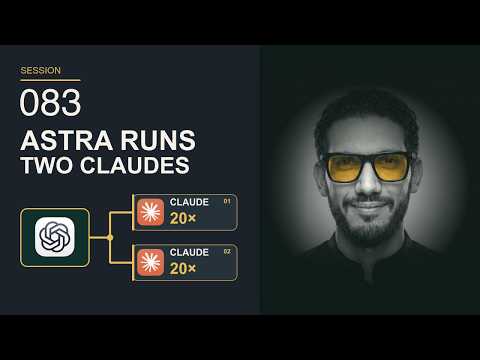
Delegating and managing Claude sessions through Astra
Luqman describes a workflow where Astra uses computer interaction to delegate work and manage Claude sessions, emphasizing knowledge of project requirements and the roadmap. He also describes accepting a prompt draft with Tab and suggests that a similar Codex workflow inside Astra might be possible, without establishing it here.
- 0:16:28
Distributing tasks around usage limits
Luqman notes the need to distribute tasks when working within AI-tool usage limits, without presenting a detailed allocation method in this passage.
- 0:21:33
Checking Claude sessions automatically every 15 minutes
Luqman describes a setup that sends a recurring prompt every 15 minutes to check work across four Claude sessions. He considers this useful for managing work when using Claude and Codex together.
- 0:22:58
Allocating Codex tasks to manage usage limits
Responding to a question about limits running out before tasks finish, Luqman recommends lighter models for routine work and stronger ones for difficult blockers, considering project size. He later adds that the maximum setting is not always necessary; these are his recommendations, without a measured comparison on this page.
- 0:23:12
Are local models an alternative when usage limits run out?
Luqman discusses local alternatives, noting that speed and quality depend on hardware and may be unsatisfactory. He explicitly acknowledges limited experience in this area and invites audience input.
- 0:26:58
Reducing advertising interruptions during a stream
Luqman expresses a preference for keeping advertising low to avoid disrupting the stream. He suggests the advertising setting as a possible explanation for behavior reported by an audience member, without confirming the cause.
- 0:29:22
Drafting a vision for an adaptive workspace that reduces the AI learning curve
Luqman dictates a request to update a vision statement around an adaptive work environment that reduces the AI learning curve, then begins requesting a review of the updated statement. The wording is fragmentary, and the page shows no completed review or implementation outcome.
- 0:30:27
Rethinking a landing-page teaser
Requests fresh landing-page teaser ideas after rejecting earlier suggestions, allowing either an extension of the current direction or a complete change.
- 0:30:57
Do OpenAI models agree too readily?
The speaker perceives OpenAI models as overly agreeable. He speculates that they may go along with minor matters to keep work moving while pushing back on important issues, presenting this as a personal impression.
- 0:36:28
Using an assistant draft to resume earlier work
Describes replacing a prompt he was preparing with an assistant-generated draft that continues earlier work, then planning to append the new request.
- 0:38:01
Requiring constant criticism can create needless objections
Discusses an audience suggestion to demand more critical feedback. Drawing on his experience, the speaker argues that mandatory criticism can overcorrect for flattery and produce objections even when an idea is good.
- 0:40:43
Tracking agent sessions through Mission Control
Luqman says working across multiple sessions makes it easy to lose track. He discusses checkpoints and a temporary Mission Control interface, and wants visibility into individual sessions and token usage alongside goal progress.
- 0:43:05
A work environment that adapts to the project
Luqman proposes a work environment that generates interface sections around a project's goals and needs, such as analytics, outreach, and Kanban boards, while retaining a stable foundation.
- 0:44:31
Estimating tokens against a complete goal
Luqman argues that a remaining-usage percentage does not explain how much the next prompt will consume. He proposes estimating tokens against a complete goal, such as finishing a website, rather than individual tasks.
- 0:45:44
Draft critique and suggested feedback prompts
Luqman describes a workflow in which the system critiques a draft and offers a prompt expressing dissatisfaction with it. He says this reduces the feedback he needs to write himself.
- 0:48:48
A question about background music availability
Asked about the music, Luqman said it had not yet been released at the time of recording. He intended to make it available on YouTube as “تركيز رقم أربعة” (“Focus Number Four”) later that night.
- 0:50:18
Continuing autonomously while requesting a progress overview
Luqman asks for autonomous work to continue and requests a bird's-eye overview of what has been completed toward the project's first milestone.
Got a question about something in this stream?
Ask in the group