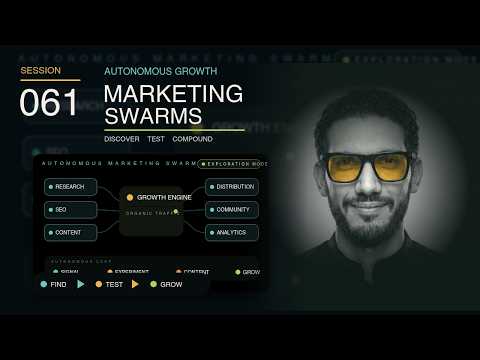
Autonomous Marketing Agent Swarms
Want to back the stream? The «داعم» membership on YouTube is EGP 60 a month: badges, emoji, and I answer your questions first on stream. Become a supporter
The gist
The stream centers on the difficult transition from building a product to entering a crowded market, emphasizing differentiation and traffic acquisition beyond paid ads alone. Luqman examines the full advertising funnel—from clicks and landing-page loads to installs and conversion—and describes using Claude through MCP to inspect Meta Ads data, while stressing that faster AI-assisted analysis cannot guarantee sales because market response remains decisive. Pricing, free trials, and limited offers are treated as hypotheses requiring sufficient traffic and behavioral data, not conclusions driven by anxiety or CTR alone. He also discusses a Shopify app that audits the AI visibility of stores and products and adds files intended to help AI systems read site content, alongside tooling that attributes traffic, revenue, and conversions to AI platforms. Conversion work includes testing whether visitors can understand the product from the website without additional explanation, investigating onboarding drop-off at a trial wall while acknowledging insufficient data to identify its cause, and distinguishing an attractive site from one whose technical performance and speed have actually been evaluated. The exploration extends to a marketing-agent swarm spanning research, content, SEO, communities, outbound outreach, and measurement, with a proposal to begin with simple loops and build a small Hermes-inspired automation layer rather than adopt an entire framework. The system was not shown to be complete or successful, and local versus VPS operation and GUI versus CLI or API access remained under investigation. The coding workflow includes quick and deeper multi-agent reviews of backend code and auditor agents that, according to the speaker, block deployment when they detect problems, as well as connecting Obsidian to assistants, dividing roles between Claude and Codex, and delegating work to Codex through a self-contained prompt. Luqman described broad spending and execution permissions as risky and said he would not grant them at that time. Other discussions address the scale of building a full CapCut-like editor, why wrapping an AI model does not automatically create a stronger model, and the suggestion to turn existing video or animation expertise into an AI-assisted product. On wider AI questions, he relays an economic view that an investment bubble could contract if expected returns fail to materialize without making the technology itself disappear. He also offers a dated, uncertain opinion that free open-source models were unlikely to overtake leading systems given their compute disadvantage, while allowing for disruptive innovation. His explanations for free model tokens and services—including speculation about a major backer or benefits from adoption and user data—remain unverified, with no confirmed backer identity. Audience discussions additionally cover switching between Codex and Claude as their performance changes at the time of recording, learning through small automation projects, freelancing and skill development, and possible guest-hosting options. Luqman explains that he chose to offer free value in Arabic despite English serving a broader commercial market, and that the replay archive helps him review progress and recover earlier ideas. He says the community motivates him and hopes the streams encourage discouraged young people to learn and work together. Growth in Arabic technical live content is presented as a hope rather than an established trend: in his view, Arabic demand was lower at the time, and he had struggled to find an existing Arabic live-building community. Across these topics, the discussion favors realistic promises, authentic reviews, and patience under market pressure, while leaving the best channel mix, pricing model, and agent architecture open to further research and testing.
135 moments from the stream
- 0:42:22
AI as a Partner for Reviewing Business Decisions
The speaker argues that an assistant retaining prior context and lacking emotional reactions can offer useful input when reviewing business decisions, presenting this as a personal view rather than a guaranteed result.
- 0:43:32
Audience Building and Differentiation in a Crowded Market
The speaker discusses building an audience before selling a product, then argues that market access is a decisive advantage and that a product facing many competitors needs clear differentiation or a strong distribution channel.
- 0:46:09
Growth Hacking Beyond Traditional Ad Channels
The speaker describes growth hacking as finding inventive ways to generate traffic and reach people beyond direct spending on Google and Facebook ads, relating competition to clicks, impressions, and audience reach.
- 0:48:10
Concrete Vision and Continuous Reassessment
The speaker emphasizes turning a vision into something concrete and working toward it, while reassessing it when setbacks occur or results differ from expectations.
- 0:48:47
Specialized Content and Outbound Outreach to Reach Merchants
The audience and speaker discuss two routes to Shopify merchants: working with specialized content creators and outbound outreach using business-data providers. Automating prospect research is also suggested, without a completed test or proven result.
- 0:51:21
Targeting and Contact Sourcing for Outbound Sales
In response to an audience question, the speaker argues that outbound outreach should target a defined audience and objective rather than use random lists, while noting that cold email can land in spam. Commercial data providers and automated data collection are mentioned as possible sourcing methods, with the speaker explicitly uncertain about the legality of the latter.
- 0:52:46
How Sales Channels Differ Between B2B and B2C
The discussion explains that email effectiveness depends on the business model: B2B relationships may involve more personal contact, meetings, and correspondence, while B2C often leans on advertising, influencers, and user-generated content. This is presented as general guidance that also depends on offer value and the customer relationship.
- 0:55:35
Value-Based Pricing and Validating the Price Hypothesis
The speaker argues that business customers may care more about value and return than price alone, and that a service intended to create meaningful impact may not fit an extremely low price. After comparing his pricing with competitors, he was advised that this alone does not prove a pricing problem; actual traffic and customer behavior should inform the decision, potentially alongside a lower-friction way to try the product.
- 0:58:32
Why Many Builders Stall at a Difficult Transition Stage
The speaker describes a difficult stage in building a business that, in his view, is where many people stall. He frames the point as an explanation of the challenge rather than a complaint, and notes generally that existing resources or visibility can make the stage easier to cross.
- 0:59:18
Cutting an Underperforming Campaign and Replacing Its Traffic
The speaker reviews an ad campaign whose lead economics were not meeting the required threshold, then pauses part of it and reduces spend. He notes that the resulting slowdown requires traffic from other channels, and that lead cost should be compared with a calculated sustainable ceiling, while qualifying that the campaign was still early and pricing was only a possible explanation, not a proven cause.
- 1:00:45
Free Trials, Pricing, and Conversion Rates
A discussion of using a free trial to demonstrate value and waiting for enough data before judging price fit. Install-to-paid conversion is presented as a possible pricing signal, while broad market benchmarks are treated as insufficient to determine one product’s performance.
- 1:04:02
Why CTR Alone Cannot Judge an Ad Campaign
Campaigns that looked promising by click metrics produced different outcomes once installs, conversion, and cost per result were considered. The speaker’s conclusion is to evaluate the full funnel and not treat Facebook ads alone as sufficient differentiation in a crowded market.
- 1:06:28
Analyzing Meta Ads Data with Claude and MCP
The speaker describes giving Claude access to Meta Ads data through MCP so it can quickly inspect placement breakdowns and tables and flag placements that may not be worth continuing. He emphasizes that faster analysis and optimization do not guarantee sales because market response remains decisive.
- 1:08:57
Link Clicks vs. Landing Page Views
A qualified explanation that a link click records the click itself, while a landing-page view likely requires the page to load. The gap can indicate bounce, loading delay, or a tracking issue, and faster page loading may reduce it.
- 1:11:38
Choosing an Ad Platform by Audience and Purchase Intent
The speaker tentatively argues that B2B advertising tends to cost more because of the audience and targeted data signals, while potentially offering higher returns than B2C. He contrasts TikTok’s cheaper reach and virality, Meta’s targeting, and Google’s ability to reach people showing search intent, while stressing that the best choice for his case remains unsettled.
- 1:16:53
A Graph-Based Marketing Agent Swarm Concept
The speaker sketches an early concept in which ads support traffic acquisition rather than serving as its only solution. One agent would periodically review research and AI developments, organize findings into documents, and let downstream agents use them to produce posts. He presents this as brainstorming and ongoing exploration of graph engineering, not a completed or tested system.
- 1:20:46
Analyzing Campaign Health Without Overcorrecting
The agent was asked to inspect campaign data and placements end to end, then decide what to do while avoiding premature overcorrection when more data may still be needed.
- 1:22:48
Prioritizing Traffic Before Further Product Development
The speaker said useful feedback had not yet been implemented because establishing a traffic pipeline was the immediate priority, rather than pausing everything for another development cycle.
- 1:23:27
Testing Product Clarity Through the Website
The website was proposed as the first explanation for people asking what the product does, using their ability to understand it unaided as a practical test of messaging clarity.
- 1:24:37
Comparing Terminal Agents and Their Access Models
The discussion compared Hermes Agent with another tool whose name is unclear in the captions, focusing on broader computer control, agent and sub-agent capabilities, and whether access can use a service subscription or requires an API. The access question remains unresolved on this page.
Got a question about something in this stream?
Ask in the group