Autonomous Marketing Agent Swarms
Want to back the stream? The «داعم» membership on YouTube is EGP 60 a month: badges, emoji, and I answer your questions first on stream. Become a supporter
The gist
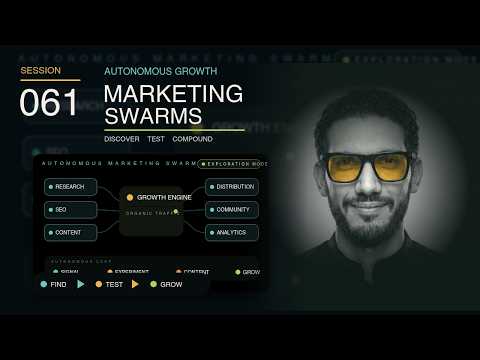
The stream centers on the difficult transition from building a product to entering a crowded market, emphasizing differentiation and traffic acquisition beyond paid ads alone. Luqman examines the full advertising funnel—from clicks and landing-page loads to installs and conversion—and describes using Claude through MCP to inspect Meta Ads data, while stressing that faster AI-assisted analysis cannot guarantee sales because market response remains decisive. Pricing, free trials, and limited offers are treated as hypotheses requiring sufficient traffic and behavioral data, not conclusions driven by anxiety or CTR alone. He also discusses a Shopify app that audits the AI visibility of stores and products and adds files intended to help AI systems read site content, alongside tooling that attributes traffic, revenue, and conversions to AI platforms. Conversion work includes testing whether visitors can understand the product from the website without additional explanation, investigating onboarding drop-off at a trial wall while acknowledging insufficient data to identify its cause, and distinguishing an attractive site from one whose technical performance and speed have actually been evaluated. The exploration extends to a marketing-agent swarm spanning research, content, SEO, communities, outbound outreach, and measurement, with a proposal to begin with simple loops and build a small Hermes-inspired automation layer rather than adopt an entire framework. The system was not shown to be complete or successful, and local versus VPS operation and GUI versus CLI or API access remained under investigation. The coding workflow includes quick and deeper multi-agent reviews of backend code and auditor agents that, according to the speaker, block deployment when they detect problems, as well as connecting Obsidian to assistants, dividing roles between Claude and Codex, and delegating work to Codex through a self-contained prompt. Luqman described broad spending and execution permissions as risky and said he would not grant them at that time. Other discussions address the scale of building a full CapCut-like editor, why wrapping an AI model does not automatically create a stronger model, and the suggestion to turn existing video or animation expertise into an AI-assisted product. On wider AI questions, he relays an economic view that an investment bubble could contract if expected returns fail to materialize without making the technology itself disappear. He also offers a dated, uncertain opinion that free open-source models were unlikely to overtake leading systems given their compute disadvantage, while allowing for disruptive innovation. His explanations for free model tokens and services—including speculation about a major backer or benefits from adoption and user data—remain unverified, with no confirmed backer identity. Audience discussions additionally cover switching between Codex and Claude as their performance changes at the time of recording, learning through small automation projects, freelancing and skill development, and possible guest-hosting options. Luqman explains that he chose to offer free value in Arabic despite English serving a broader commercial market, and that the replay archive helps him review progress and recover earlier ideas. He says the community motivates him and hopes the streams encourage discouraged young people to learn and work together. Growth in Arabic technical live content is presented as a hope rather than an established trend: in his view, Arabic demand was lower at the time, and he had struggled to find an existing Arabic live-building community. Across these topics, the discussion favors realistic promises, authentic reviews, and patience under market pressure, while leaving the best channel mix, pricing model, and agent architecture open to further research and testing.
135 moments from the stream
- 4:05:36
Borrowing Hermes Automation Without Rebuilding It All
The speaker discussed experimenting with a smaller system that borrows only needed pieces from Hermes—such as scheduling, heartbeats, and background processes—instead of recreating the whole system. He attributed the idea to advice he received and presented it as an unresolved experiment, while expressing an uncertain view that Hermes has a strong agent harness.
- 4:07:19
A Good-Looking Site Is Not Yet Technically Polished
The speaker clarified that the website may look visually good but has not yet been technically polished or evaluated for speed, distinguishing appearance from performance readiness.
- 4:14:25
Reducing Distraction Before Shipping Changes
The speaker said he would fix an issue if it proved significant but wanted to avoid distraction from too many options. He then requested a description or mockup showing how a selected set of changes would look before shipping them that week.
- 4:22:28
AI Response Latency in Onboarding
A practical concern was raised about waiting for AI responses during onboarding, where the stated aim was a very fast experience that does not force customers to wait. The passage reports no test or confirmed solution.
- 4:23:09
Why Are Model Tokens Offered for Free?
The speaker discussed the cost of offering free model tokens and speculated that substantial investment or a major backer might be involved, while explicitly saying the backer's identity was unknown. These remained suspicions, not established facts.
- 4:25:13
Building an Automation Foundation for Marketing Agents
The speaker described focusing on a foundation for marketing agents and creating a dedicated repository to duplicate part of an existing automation, with the outcome still to be seen.
- 4:26:02
The Non-Monetary Tradeoff of Free Services
The speaker agreed with an audience view that a free service may benefit from user data and explained that broad adoption can be a longer-term investment. He also repeated an unverified guess that a major backer was involved, without confirmed evidence of its identity.
- 4:30:00
A Free-Access Option for Burnish
A proposal was raised for every visitor to receive an initial scan and a limited set of free answers, such as reputation and discovery information.
- 4:31:57
Choosing Coding Tools by Efficiency and Usage Limits
Responding to an audience question, the speaker offered personal opinions comparing Codex, Claude, Cursor, and Grok by work efficiency and usage limits, suggesting that complementary tools may suit some heavier workloads.
- 4:33:49
Extracting the Minimum Needed from Hermes
The speaker said the useful subset of the Hermes pattern was operational functionality such as scheduling and heartbeats, rather than the full idea of a self-evolving agent; the exchange ended with recognition that the participants might have meant different things.
- 4:35:12
Diversifying Marketing with Cold Outreach
The speaker said cold email outreach remained part of the plan, mentioned Apollo as a potential tool or data source for that outreach, and argued that relying on advertising alone was not a sound strategy.
- 4:36:38
Auditor Agents as Backend Deployment Gates
The speaker described a crew of auditor agents that supports backend work and blocks deployment when issues are detected, making automated review a pre-release gate.
- 4:39:37
Questions About Full Automation and Choosing GUI or CLI
The speaker discusses the challenge of running GUI tools and Codex concurrently across multiple machines and asks whether a CLI would be better for full automation. As a practical opinion, he notes that some automation paths may require API access.
- 4:42:17
Choosing a Coding Assistant for the Workload
The speaker compares his experience with Cursor and Antigravity, arguing that a developer may not always need the smartest model so much as a tool that fits the workload and working style.
- 4:45:12
Selling Websites Through Freelance Platforms
An audience member asks whether a teaching platform they built can be sold. The speaker says web development has a market, emphasizing skill, a strong portfolio, and promotion through freelance platforms such as Upwork.
- 4:48:23
Reducing Task Scope to Limit Model Hallucinations
In the speaker's experience, Gemini Flash works acceptably in Antigravity when work is divided into small pieces, but struggles and hallucinates more on larger scopes.
- 4:49:56
Build the Skill Before Entering the Market
The speaker advises against rushing: identify a field the learner enjoys, develop that skill with help from AI, and enter the market after building a stronger foundation.
- 4:55:38
Researching Competitor Pricing and Trials Without Fabrication
The speaker pauses strategy work to conduct more focused market research into Shopify AEO app pricing, plans, and free trials, stressing that no result is better than fabricated information.
- 5:00:42
Building Local Automation Instead of Fully Relying on an External Tool
The discussion considers creating a small repository that adopts a limited part of an external tool’s automation concept while acknowledging that some of its capabilities would be lost. It calls for another review of the tool and a clear description of the finished system before choosing a direction.
- 5:03:06
Options for Hosting Guests on Live Streams
In response to an audience question, the speaker discusses having multiple people appear on a live stream and tentatively suggests Telegram, while noting limited familiarity with it. StreamYard is then raised in the discussion, and Kick is described as a Twitch-like streaming platform, without confirming guest-hosting capabilities for either one.
Got a question about something in this stream?
Ask in the group