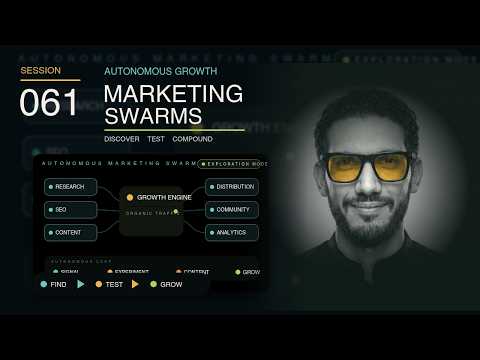
Autonomous Marketing Agent Swarms
Want to back the stream? The «داعم» membership on YouTube is EGP 60 a month: badges, emoji, and I answer your questions first on stream. Become a supporter
The gist
The stream centers on the difficult transition from building a product to entering a crowded market, emphasizing differentiation and traffic acquisition beyond paid ads alone. Luqman examines the full advertising funnel—from clicks and landing-page loads to installs and conversion—and describes using Claude through MCP to inspect Meta Ads data, while stressing that faster AI-assisted analysis cannot guarantee sales because market response remains decisive. Pricing, free trials, and limited offers are treated as hypotheses requiring sufficient traffic and behavioral data, not conclusions driven by anxiety or CTR alone. He also discusses a Shopify app that audits the AI visibility of stores and products and adds files intended to help AI systems read site content, alongside tooling that attributes traffic, revenue, and conversions to AI platforms. Conversion work includes testing whether visitors can understand the product from the website without additional explanation, investigating onboarding drop-off at a trial wall while acknowledging insufficient data to identify its cause, and distinguishing an attractive site from one whose technical performance and speed have actually been evaluated. The exploration extends to a marketing-agent swarm spanning research, content, SEO, communities, outbound outreach, and measurement, with a proposal to begin with simple loops and build a small Hermes-inspired automation layer rather than adopt an entire framework. The system was not shown to be complete or successful, and local versus VPS operation and GUI versus CLI or API access remained under investigation. The coding workflow includes quick and deeper multi-agent reviews of backend code and auditor agents that, according to the speaker, block deployment when they detect problems, as well as connecting Obsidian to assistants, dividing roles between Claude and Codex, and delegating work to Codex through a self-contained prompt. Luqman described broad spending and execution permissions as risky and said he would not grant them at that time. Other discussions address the scale of building a full CapCut-like editor, why wrapping an AI model does not automatically create a stronger model, and the suggestion to turn existing video or animation expertise into an AI-assisted product. On wider AI questions, he relays an economic view that an investment bubble could contract if expected returns fail to materialize without making the technology itself disappear. He also offers a dated, uncertain opinion that free open-source models were unlikely to overtake leading systems given their compute disadvantage, while allowing for disruptive innovation. His explanations for free model tokens and services—including speculation about a major backer or benefits from adoption and user data—remain unverified, with no confirmed backer identity. Audience discussions additionally cover switching between Codex and Claude as their performance changes at the time of recording, learning through small automation projects, freelancing and skill development, and possible guest-hosting options. Luqman explains that he chose to offer free value in Arabic despite English serving a broader commercial market, and that the replay archive helps him review progress and recover earlier ideas. He says the community motivates him and hopes the streams encourage discouraged young people to learn and work together. Growth in Arabic technical live content is presented as a hope rather than an established trend: in his view, Arabic demand was lower at the time, and he had struggled to find an existing Arabic live-building community. Across these topics, the discussion favors realistic promises, authentic reviews, and patience under market pressure, while leaving the best channel mix, pricing model, and agent architecture open to further research and testing.
135 moments from the stream
- 3:13:24
Clarifying Knowledge Limits in AI-Agent Security
After initially interpreting the question as building a security agent inside a code repository, the speaker realizes it concerns a different field or study and explicitly says he has not read about it and does not understand its details well.
- 3:17:24
Delegating a Task to Codex with a Self-Contained Prompt
He asks for a self-contained prompt to delegate a task to Codex, as part of a workflow that distributes work across tools while keeping human attention on strategy.
- 3:18:24
Why He Chose Arabic Streams and the Value of Replay Archives
He says English might serve a broader commercial market, but he prefers offering free value in Arabic. He also finds the stream archive useful for reviewing progress and recovering earlier ideas.
- 3:20:13
Spreading Work Across AI Tools
He suggests using multiple AI platforms together and allocating resources across them, or choosing one when focus is needed, as a practical way to benefit from different strengths.
- 3:21:39
An Early Stream Website Using the YouTube API
He describes his first website, which still exposes the current stream and past replays through the YouTube API, while acknowledging that its design and content need further refinement.
- 3:22:26
Mutual Encouragement and Working Together Through Discouragement
He says the stream and its community motivate him as well, and frames any success as a shared effort. He hopes to encourage discouraged young people by showing that learning and working together are possible.
- 3:25:39
Dividing Roles Between Claude and Codex
He describes his current preference for using Claude interactively while delegating prompts and execution work to Codex at a fast setting. This is his workflow opinion, not a controlled comparison.
- 3:26:11
The Marketing Battle Starts After the Product Is Built
He describes the shock of facing the market after a period of building and how discouragement can tempt a founder toward another idea. In his view, the real challenge starts after completion: differentiating in a crowded market and solving marketing and traffic acquisition, while product-quality feedback is a later problem that can be addressed.
- 3:28:36
Contracting as a Path for Builders Who Dislike Marketing
He criticizes repeatedly jumping between self-directed projects, but distinguishes that from contracting: someone who enjoys technical building and not marketing can build commissioned work, deliver it, and then move to another assignment.
- 3:29:44
Opening the Trial-Gate Discussion
He opens a practical discussion about how to design a trial gate and what options are currently available, but these pages do not capture a subsequent answer or decision.
- 3:42:07
Designing a Goal-Directed Marketing-Agent Swarm
The speaker envisions several agents, each pursuing a specific marketing goal with room to act autonomously, while still accepting broad directions instead of requiring every step or strategy to be prescribed.
- 3:45:02
Envisioning the Final Workflow and Local Execution
The discussion works backward from a completed product to request a concrete workflow example, then notes a preference for running agents locally because setting up a VPS would add time and a learning curve.
- 3:47:43
Arabic vs. English for AI Prompting
The speaker discusses prompting in English rather than Arabic and reports that his research indicated lower token usage in English, while stressing that the difference is not large and acknowledging the value of translating prompts for the audience.
- 3:49:04
Grilling and Brainstorming Skills with Claude and Codex
The speaker discusses skills for interrogating and refining an idea, observing from his experience that Claude and Codex may ask questions differently. He also notes that the Superpowers collection includes brainstorming capabilities that may remove the need for a separate skill.
- 3:52:26
Reducing Drop-Off at an Onboarding Trial Wall
The speaker describes an onboarding flow where users reach a trial-subscription step and then leave. He says there is not yet enough data to identify the cause, so possible retention improvements are being evaluated rather than treated as a confirmed diagnosis.
- 3:54:23
Scoping a CapCut-Like Editor and the Limits of AI Wrappers
The speaker cautions that building a full CapCut-like application is a large undertaking, even though clone repositories exist. He explains that wrapping an AI model does not automatically create a stronger model and recommends turning existing video or animation expertise into an AI-assisted product.
- 3:57:22
A Talk-to-the-Founder Pricing Option
A fourth pricing-page option was proposed that invites prospects to talk to the founder, opening a direct conversation with merchants or potential customers.
- 3:59:36
Improving Shopify Store Visibility on AI Platforms
The speaker described a Shopify app that audits a merchant’s business and products, scores visibility, and adds files intended to make site content easier for AI systems to read. He also described attribution tooling for traffic, revenue, and conversions from AI platforms, framed around the gradual shift from traditional search toward AI assistants.
- 4:02:54
Creative Differentiation to Drive Free Trials
The speaker argued that a highly competitive market demands more creative ideas and clearer differentiation from competitors, while making the product’s value visible. The immediate practical goal was to encourage visitors to begin a free trial.
- 4:04:20
Multi-Agent Crews for Code Review
The speaker described configured crews of agents that review backend code after implementation: a quick path for routine checks and a deeper path for important work. He said these reviews repeatedly uncover issues, while noting that the deeper path requires more time and resources.
Got a question about something in this stream?
Ask in the group