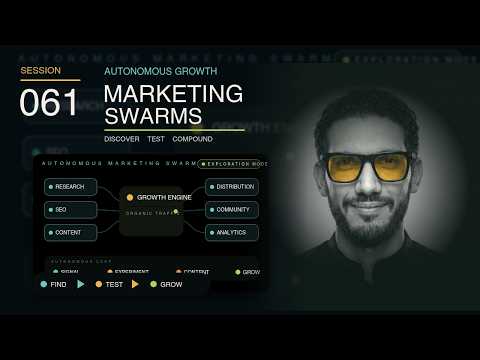
Autonomous Marketing Agent Swarms
Want to back the stream? The «داعم» membership on YouTube is EGP 60 a month: badges, emoji, and I answer your questions first on stream. Become a supporter
The gist
The stream centers on the difficult transition from building a product to entering a crowded market, emphasizing differentiation and traffic acquisition beyond paid ads alone. Luqman examines the full advertising funnel—from clicks and landing-page loads to installs and conversion—and describes using Claude through MCP to inspect Meta Ads data, while stressing that faster AI-assisted analysis cannot guarantee sales because market response remains decisive. Pricing, free trials, and limited offers are treated as hypotheses requiring sufficient traffic and behavioral data, not conclusions driven by anxiety or CTR alone. He also discusses a Shopify app that audits the AI visibility of stores and products and adds files intended to help AI systems read site content, alongside tooling that attributes traffic, revenue, and conversions to AI platforms. Conversion work includes testing whether visitors can understand the product from the website without additional explanation, investigating onboarding drop-off at a trial wall while acknowledging insufficient data to identify its cause, and distinguishing an attractive site from one whose technical performance and speed have actually been evaluated. The exploration extends to a marketing-agent swarm spanning research, content, SEO, communities, outbound outreach, and measurement, with a proposal to begin with simple loops and build a small Hermes-inspired automation layer rather than adopt an entire framework. The system was not shown to be complete or successful, and local versus VPS operation and GUI versus CLI or API access remained under investigation. The coding workflow includes quick and deeper multi-agent reviews of backend code and auditor agents that, according to the speaker, block deployment when they detect problems, as well as connecting Obsidian to assistants, dividing roles between Claude and Codex, and delegating work to Codex through a self-contained prompt. Luqman described broad spending and execution permissions as risky and said he would not grant them at that time. Other discussions address the scale of building a full CapCut-like editor, why wrapping an AI model does not automatically create a stronger model, and the suggestion to turn existing video or animation expertise into an AI-assisted product. On wider AI questions, he relays an economic view that an investment bubble could contract if expected returns fail to materialize without making the technology itself disappear. He also offers a dated, uncertain opinion that free open-source models were unlikely to overtake leading systems given their compute disadvantage, while allowing for disruptive innovation. His explanations for free model tokens and services—including speculation about a major backer or benefits from adoption and user data—remain unverified, with no confirmed backer identity. Audience discussions additionally cover switching between Codex and Claude as their performance changes at the time of recording, learning through small automation projects, freelancing and skill development, and possible guest-hosting options. Luqman explains that he chose to offer free value in Arabic despite English serving a broader commercial market, and that the replay archive helps him review progress and recover earlier ideas. He says the community motivates him and hopes the streams encourage discouraged young people to learn and work together. Growth in Arabic technical live content is presented as a hope rather than an established trend: in his view, Arabic demand was lower at the time, and he had struggled to find an existing Arabic live-building community. Across these topics, the discussion favors realistic promises, authentic reviews, and patience under market pressure, while leaving the best channel mix, pricing model, and agent architecture open to further research and testing.
135 moments from the stream
- 1:25:53
Testing Google Ads Alongside Meta Ads
The audience suggested testing Google Ads alongside Meta Ads rather than relying on one channel, while the speaker acknowledged that the earlier campaign setup had been rushed. Private budget and personal circumstances are omitted.
- 1:28:31
AI Campaign Audits and Diagnosing the Wider Offer
The speaker described asking Claude to access a campaign through MCP and audit performance and placements. He argued that increasingly capable ad tools may expose remaining weaknesses in pricing, branding, or the underlying business, but this was an opinion rather than a demonstrated test result.
- 1:29:37
Affiliate Marketing Compensation Models
The discussion explained that some affiliates work solely for a sales percentage, while larger arrangements may combine an upfront payment with a revenue share for a defined period. Numeric financial examples are omitted.
- 1:30:24
Do Campaign Changes Reset the Learning Phase?
A question was raised about whether campaign modifications had reset the learning phase, but the intended next step and answer are cut off at the end of the page.
- 1:38:38
Planning an Always-On Autonomous Marketing-Agent System
The speaker returned to autonomous marketing agents and requested research and a plan for using an always-on secondary machine, with clear responsibilities assigned across several agents. He relayed advice to begin with loop engineering and defer graph engineering until roles and processes are more established.
- 1:41:51
From Prompt Engineering to Loops and Graphs
Answering an audience question, the speaker described loop engineering as useful for recurring or scheduled work such as news and email delivery, and contrasted it with graph engineering as broader coordination of agents acting like a team. He imagined systems moving from detailed prompts to receiving a goal, assessing feasibility, and requesting the access needed to pursue it; however, on 26 August he explicitly said his understanding of graph engineering was still preliminary and some conclusions were speculation based on industry comments.
- 1:59:42
Building Only the Needed Part of Hermes for Marketing Agents
An exploratory discussion about creating a foundation for autonomous marketing agents intended to attract traffic beyond advertising platforms. The proposal is not to reproduce all of Hermes, but to add a small subset of its capabilities around Claude’s agent runtime and tools while accounting for the distinction between subscription access and API calls. The captions do not establish that the system was built or succeeded, and its feasibility remained uncertain.
- 2:05:08
Can an Open-Source Model Overtake Leading Systems?
The speaker argued at the time of this discussion that a free open-source model was unlikely to overtake leading systems such as Claude and Codex because major providers possess greater compute and resources. He presented this as an uncertain opinion, however, and allowed that a disruptive innovation resembling DeepSeek’s early impact could still emerge.
- 2:06:36
Inspecting Ad Placements Through Claude MCP
The speaker says connecting ad-placement data and metrics to Claude MCP could enable rapid inspection of placements and problems. The captions present this as a general idea and do not establish an implementation or test result.
- 2:08:09
Building Only the Needed Layer Instead of a Full Agent Framework
The speaker discusses advice attributed to research and a coding tool: a small custom scheduling and automation layer might be enough on top of the existing runtime instead of adopting an entire agent framework. Actual compatibility remained unresolved, and the captions do not establish a successful test.
- 2:10:23
Diversifying Traffic Channels for B2B Marketing
The speaker argues that marketing automation should support several distinct traffic-acquisition paths, because relying only on ads or a single channel creates unnecessary risk. This is presented as a general strategic opinion, not a demonstrated test result.
- 2:11:27
Choosing Between Codex and Claude Based on Current Performance
Answering a question about resuming mobile-app development, the speaker preferred Codex for working efficiency at the time of recording, while stressing that tool performance changes and users should move to whichever platform is currently stronger. He cited a reported Claude issue in March 2026 and improvement he observed in May, making this a dated personal assessment rather than a permanent verdict.
- 2:13:15
Requesting an Architecture Plan Before Implementation
The speaker asks the assistant for a clear English direction and implementation plan, including whether the work should live in a separate repository or inside the current one before development begins.
- 2:13:58
Automating Nuisance-Bot Detection
After noticing disruptive automated accounts, the speaker proposes building a tool to detect this behavior automatically. The captions provide no design, implementation, or test result.
- 2:14:18
Platform Presence and AI Discoverability
An audience comment argues that a project should be presented so users can discover it when asking AI tools about relevant tools or apps, and the speaker agrees that presence on an appropriate platform matters. Some names and terms in this exchange are unclear, so no specific product is attributed.
- 2:15:56
Exploring Shopify Communities as a Traditional Channel
An audience member suggests starting with a conventional channel such as Shopify groups, and the speaker asks for more detail to understand the idea. The suggestion remains preliminary and is not presented as a plan or validated experiment.
- 2:17:38
Repository Architecture for Autonomous Marketing Agents
A proposed repository for marketing agents, with queues, runs, and a digest or ledger in its structure. The agents would receive access to content tools and the website or application to pursue marketing goals, with a longer-term vision of broader automation that could include changing prices automatically.
- 2:24:12
Using Online Communities for Lead Discovery
A discussion of using Shopify communities, Reddit, and similar groups not only for domain knowledge but also to find people with genuine needs. The proposed system would automate research, posting, and lead discovery instead of spreading those recurring tasks across several manual marketing roles.
- 2:25:49
Why Focus on Marketing When the Product Produces Results?
Answering an audience question, the speaker said the product largely works and produces results, though results emerge relatively slowly in this field. He emphasized that customers care more about outcomes than the underlying technology, and said the current marketing focus is intended to increase traffic before assessing further refinements.
- 2:27:10
Designing an Agent Swarm Around Specific Goals
The speaker outlines a system of several agents, each assigned a measurable objective rather than a traditional job role. He recounts a model’s hypothetical claim that it could pursue a business outcome if given tools and permissions, while stressing that broad spending and execution access remains risky and is not something he would grant now.
Got a question about something in this stream?
Ask in the group