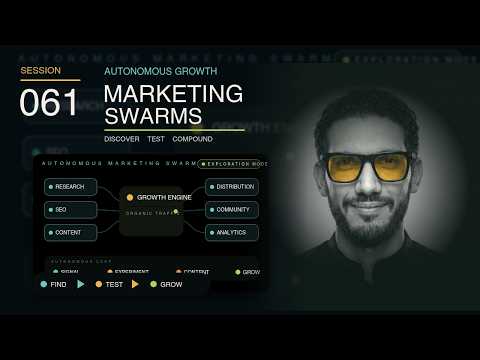
Autonomous Marketing Agent Swarms
Want to back the stream? The «داعم» membership on YouTube is EGP 60 a month: badges, emoji, and I answer your questions first on stream. Become a supporter
The gist
The stream centers on the difficult transition from building a product to entering a crowded market, emphasizing differentiation and traffic acquisition beyond paid ads alone. Luqman examines the full advertising funnel—from clicks and landing-page loads to installs and conversion—and describes using Claude through MCP to inspect Meta Ads data, while stressing that faster AI-assisted analysis cannot guarantee sales because market response remains decisive. Pricing, free trials, and limited offers are treated as hypotheses requiring sufficient traffic and behavioral data, not conclusions driven by anxiety or CTR alone. He also discusses a Shopify app that audits the AI visibility of stores and products and adds files intended to help AI systems read site content, alongside tooling that attributes traffic, revenue, and conversions to AI platforms. Conversion work includes testing whether visitors can understand the product from the website without additional explanation, investigating onboarding drop-off at a trial wall while acknowledging insufficient data to identify its cause, and distinguishing an attractive site from one whose technical performance and speed have actually been evaluated. The exploration extends to a marketing-agent swarm spanning research, content, SEO, communities, outbound outreach, and measurement, with a proposal to begin with simple loops and build a small Hermes-inspired automation layer rather than adopt an entire framework. The system was not shown to be complete or successful, and local versus VPS operation and GUI versus CLI or API access remained under investigation. The coding workflow includes quick and deeper multi-agent reviews of backend code and auditor agents that, according to the speaker, block deployment when they detect problems, as well as connecting Obsidian to assistants, dividing roles between Claude and Codex, and delegating work to Codex through a self-contained prompt. Luqman described broad spending and execution permissions as risky and said he would not grant them at that time. Other discussions address the scale of building a full CapCut-like editor, why wrapping an AI model does not automatically create a stronger model, and the suggestion to turn existing video or animation expertise into an AI-assisted product. On wider AI questions, he relays an economic view that an investment bubble could contract if expected returns fail to materialize without making the technology itself disappear. He also offers a dated, uncertain opinion that free open-source models were unlikely to overtake leading systems given their compute disadvantage, while allowing for disruptive innovation. His explanations for free model tokens and services—including speculation about a major backer or benefits from adoption and user data—remain unverified, with no confirmed backer identity. Audience discussions additionally cover switching between Codex and Claude as their performance changes at the time of recording, learning through small automation projects, freelancing and skill development, and possible guest-hosting options. Luqman explains that he chose to offer free value in Arabic despite English serving a broader commercial market, and that the replay archive helps him review progress and recover earlier ideas. He says the community motivates him and hopes the streams encourage discouraged young people to learn and work together. Growth in Arabic technical live content is presented as a hope rather than an established trend: in his view, Arabic demand was lower at the time, and he had struggled to find an existing Arabic live-building community. Across these topics, the discussion favors realistic promises, authentic reviews, and patience under market pressure, while leaving the best channel mix, pricing model, and agent architecture open to further research and testing.
135 moments from the stream
- 0:02:46
Diversifying Traffic Beyond Paid Ads
Luqman argues that relying only on advertising can lead to losses, so he is interested in growth-hacking methods that may generate traffic and wants to see their results.
- 0:04:49
From Loops to Graph Engineering for AI Agents
In August 2026, Luqman says he is reading about graph engineering and attributes to some people in the field a view that AI may increasingly be given a goal to pursue instead of being managed in fine detail.
- 0:06:08
Letting Ads Learn Before Evaluation
Luqman explains that campaigns need a learning period to test creatives and review metrics such as click-through rate before their results are judged.
- 0:06:37
AI Cannot Guarantee an Advertising Outcome
Luqman notes that asking AI for a specific advertising result does not guarantee it: the system can do what it can, but the market ultimately determines the outcome.
- 0:07:10
Ads Buy Targeted Traffic; the Goal Is Free Traffic
Luqman reframes advertising as a way to obtain relevant, targeted traffic and says he wants to find free traffic. The acquisition mechanism is unclear in the supplied captions.
- 0:08:45
Building a Company or Personal Brand with AI
Answering an audience question, Luqman explains that building an AI-assisted company depends on its type and scale, while a personal brand can begin when someone has content they want to share with an audience.
- 0:11:28
How a Marketing-Agent Swarm Can Work
A conceptual multi-agent marketing system: an orchestrator distributes research, channel agents turn it into posts or search-oriented content, and another agent monitors results. The roles can be arranged as a loop or graph so agents pass outputs through a shared workflow.
- 0:14:54
Choosing Agent-Automation Tools Remains an Open Question
The speaker explores whether the system needs a specialized automation platform or could be implemented with general tools such as Claude or Codex, explicitly noting that the tradeoff is still under investigation.
- 0:17:14
From Prompt Engineering to Loops and Graphs
The speaker’s view of AI-system design moves from prompt engineering to goal-driven agents in loops, then to graphs coordinating multiple agents. He presents graph engineering as a deeper area he is still learning about.
- 0:20:21
Balancing Ads with Visibility and Ranking
The speaker argues that ads should not be the only route and suggests pairing them with efforts to secure prominent placement that can generate additional impressions.
- 0:22:35
Differentiating in a Crowded Market
The speaker argues that building a strong product is not sufficient by itself and that success in a highly competitive market requires clear differentiation.
- 0:23:19
Pricing Needs Enough Traffic to Evaluate
The discussion explains that insufficient traffic makes it difficult to identify why demand is weak, while higher pricing may support a lower-volume model and lower pricing requires greater volume.
- 0:24:22
Importing Structured JSON Content
A participant describes a workflow that requires content to follow a fixed JSON format and then allows it to be imported directly into the website once prepared.
- 0:26:32
Visibility and Capital as Competitive Factors
The speaker argues that project quality does not guarantee visibility and that less differentiated competitors may prevail through greater recognition. He adds that capital can be used to acquire customers from rivals in a crowded market.
- 0:29:14
Entering the Market Through Multiple Channels
The speaker advises against relying on advertising alone and recommends preparing to enter the market through several complementary routes.
- 0:30:59
Why Direct-to-Install Ads Can Struggle
A comparison explaining that sending traffic straight to an install page can struggle when the ad platform lacks enough conversions to learn and identify the right audience.
- 0:31:52
A Value-First Acquisition Funnel
A funnel that begins with a free store scan and a report informed by several AI platforms, followed by email nurturing intended to build trust and encourage an app install.
- 0:34:23
Keeping an App Listing Focused on One Goal
In an audience discussion, the speaker explains that the app listing should not distract visitors from the install goal, while the free scan is already available within the trial.
- 0:36:53
Avoiding Premature Pricing Changes
The speaker discusses weak results from a direct page, the need for data points to improve targeting, and concern about pricing, while acknowledging that there are not yet enough users to establish price as the cause and that some intuitive judgments remain debatable.
- 0:39:39
The Difficulty of Launch and Distribution
The speaker views launch and distribution as among the hardest phases of a project, comparing them with a difficult early stage from prior business experience roughly nine years earlier.
Got a question about something in this stream?
Ask in the group