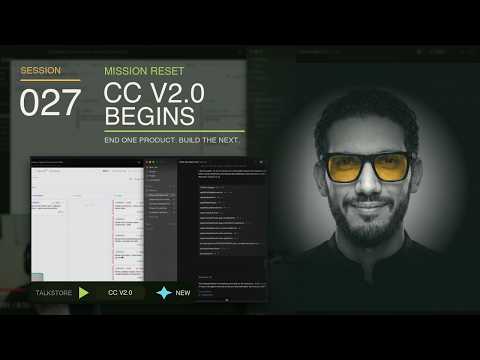
RIP. NEW MISSION. CC V2.0
Want to back the stream? The «داعم» membership on YouTube is EGP 60 a month: badges, emoji, and I answer your questions first on stream. Become a supporter
The gist
The stream centers on redesigning a largely autonomous “Command Center” that routes coding tasks by size and dependency, delegates research, exploration, and implementation to agents, and introduces task- and milestone-level audits before human review. Luqman demonstrates unfinished practical work across Codex, Claude, and terminal workflows, weighing output quality against token consumption and usage limits while encountering real friction involving Supabase, Docker, MCP, and stalled tasks; the workflow is therefore not presented as a completed success. The discussion broadens to unit testing, lightweight feature specifications, competitor research before building, and the need to market products rather than stopping after implementation. He also outlines a Shopify tool concept for measuring and improving product visibility in AI answers through GEO, which he described at the time of the 2026 recording as an emerging field and forecast to grow, particularly toward late 2026, while leaving market viability, implementation complexity, and the GEO–AEO distinction unresolved. Drawing on experience that began with dropshipping in 2017, Luqman compares dropshipping with DTC and white labeling, e-commerce with app economics, and B2B with experimental B2C directions; he also offers opinions on SaaS margins and recurring revenue, reasons for choosing the Shopify ecosystem, and app marketing through defined audiences, acquisition channels, and a mix of organic and paid approaches, without presenting these views as guarantees or settled outcomes. Secondary discussions cover automated short clips and the risk of lost context, recorded streams as a work archive and community-learning channel, programmatic marketing videos with Remotion, thumbnail experiments, and copyright constraints. Audience questions add useful discussions about learning software development through practical AI-assisted projects, verifying the security and provenance of agent skills, estimating time, managing dependencies, model pricing and compute efficiency, and scheduling work around session limits. The qualified conclusion is that automation may reduce manual coordination but does not remove the need for oversight, debugging, and validation; Luqman argues that strong planning and context matter more than minimizing token use alone.
155 moments from the stream
- 7:52:55
Does the Difference Come From the Tool or the Model?
The discussion raises the possibility that behavioral differences come from the tools and their design philosophies rather than the model alone, while attributing the idea that their developers may use substantially different technical approaches to a cited outside discussion.
- 7:54:45
What Practical OpenClaw Adoption Requires
The speaker argues that OpenClaw is not overhyped, but requires learning time and budget management. Potential uses include marketing automation and organic marketing, with the possibility of configuring it to work autonomously with Codex; no tested or successful outcome is claimed.
- 7:58:55
Withholding Judgment When Context Is Limited
The speaker cautions against immediately judging work still running in the background, explaining that it was given no context beyond the manifesto itself.
- 7:59:51
Exploring the Difference Between AEO and GEO
The speaker explores the terms AEO and GEO, questioning which is the primary label and how they differ. The exact distinction remains unresolved in this discussion.
- 8:01:48
Comparing SEO Changes with the Rise of AEO
The speaker compares recent changes in SEO with the rise of AEO, without establishing a settled definition or outcome.
- 8:04:05
Automating Architectural Decisions
The speaker proposes automating some architectural decisions that normally require human input, drawing—by his account—on the example of a system supporting military-targeting decisions, without demonstrating an implementation or proven results.
- 8:07:17
Evaluating Coding Tools During a Rendering Failure
The speaker expresses frustration with a coding tool despite extensive use of tools such as Codex, while acknowledging the issue might be his own mistake. He asks to launch the server and observes a black screen with nothing rendering, but reaches no confirmed diagnosis.
- 8:08:24
A View on B2B Margins and B2C Experimentation
The speaker views B2B as potentially offering strong margins and presents B2C as a direction that can be tested experimentally, without giving a quantitative comparison or a definitive result.
- 8:11:32
Providing a Brand Palette for a Design Workflow
The speaker offers to provide the other participant with the brand palette and supporting materials, then see what can be produced, while generally praising the apparent workflow.
- 8:11:56
From Dropshipping to DTC and White Labeling
The speaker says he started dropshipping in 2017 and later moved to a DTC model built on direct supplier relationships and possible white labeling. Based on his experience, he considers dropshipping difficult to operate in Egypt for several reasons, not customs alone.
- 8:13:43
A Simple Logo Idea Using a Shape and Project Element
A brief discussion reflecting limited logo-design expertise, with a simple example involving a project element, a geometric shape, and a name, without clarifying which inspired which.
- 8:18:42
Estimating Remaining Project Time Realistically
The speaker estimates development time from the current pace of progress, while noting that debugging and additional work such as marketing, videos, Shopify setup, and the website remain outside that estimate.
- 8:23:12
Revenue and Profitability in E-commerce Versus Apps
The speaker argues that generating sales through dropshipping or e-commerce may be easier than through applications, while applications can offer stronger margins.
- 8:29:34
Why Investors May Favor SaaS Companies
Drawing on his experience around investors, the speaker argues that SaaS companies can be attractive because of high margins and recurring revenue, including ARR and MRR.
- 8:32:16
Build and Market Instead of Immediately Moving On
The speaker emphasizes that the goal should not be merely to build a product and move to another idea, but to market it and follow the steps involved in turning it into a revenue-generating business.
Got a question about something in this stream?
Ask in the group