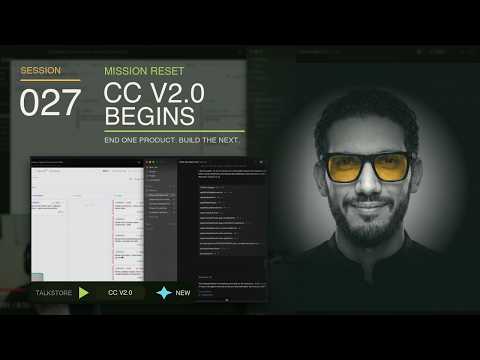
RIP. NEW MISSION. CC V2.0
Want to back the stream? The «داعم» membership on YouTube is EGP 60 a month: badges, emoji, and I answer your questions first on stream. Become a supporter
The gist
The stream centers on redesigning a largely autonomous “Command Center” that routes coding tasks by size and dependency, delegates research, exploration, and implementation to agents, and introduces task- and milestone-level audits before human review. Luqman demonstrates unfinished practical work across Codex, Claude, and terminal workflows, weighing output quality against token consumption and usage limits while encountering real friction involving Supabase, Docker, MCP, and stalled tasks; the workflow is therefore not presented as a completed success. The discussion broadens to unit testing, lightweight feature specifications, competitor research before building, and the need to market products rather than stopping after implementation. He also outlines a Shopify tool concept for measuring and improving product visibility in AI answers through GEO, which he described at the time of the 2026 recording as an emerging field and forecast to grow, particularly toward late 2026, while leaving market viability, implementation complexity, and the GEO–AEO distinction unresolved. Drawing on experience that began with dropshipping in 2017, Luqman compares dropshipping with DTC and white labeling, e-commerce with app economics, and B2B with experimental B2C directions; he also offers opinions on SaaS margins and recurring revenue, reasons for choosing the Shopify ecosystem, and app marketing through defined audiences, acquisition channels, and a mix of organic and paid approaches, without presenting these views as guarantees or settled outcomes. Secondary discussions cover automated short clips and the risk of lost context, recorded streams as a work archive and community-learning channel, programmatic marketing videos with Remotion, thumbnail experiments, and copyright constraints. Audience questions add useful discussions about learning software development through practical AI-assisted projects, verifying the security and provenance of agent skills, estimating time, managing dependencies, model pricing and compute efficiency, and scheduling work around session limits. The qualified conclusion is that automation may reduce manual coordination but does not remove the need for oversight, debugging, and validation; Luqman argues that strong planning and context matter more than minimizing token use alone.
155 moments from the stream
- 5:32:41
A Commit Blocked While a Process Was Still Running
During the work, the speaker noticed that the workflow was stuck and tentatively concluded that a commit could not be made while the current process was still running.
- 5:33:44
A Reported Policy for a Coding-Only Plan
The speaker relayed a report about an unclearly identified company whose plan would be restricted to programming, with other uses potentially leading to throttling or suspension. He opined that this specialization might help the service improve its coding capabilities relative to other models.
- 5:36:28
Choosing an App Marketing Strategy
The discussion recommends defining the target audience and acquisition channels first, then balancing organic growth with paid advertising. The speaker argues that a limited budget makes organic marketing more suitable, while the viability of paid campaigns depends on the platform and objective.
- 5:40:48
When Does a PRD Become Overkill?
The speaker says he previously used product requirements documents but did not continue because they sometimes felt heavier than necessary, while direct, iterative interaction with agents suited him better. He presents this as a personal experience worth revisiting, not a general argument against PRDs.
- 5:42:50
An Automated Agent Execution and Review Loop
The speaker describes a workflow where an agent completes explicitly defined tasks in sequence and an auditor agent reviews each one before approval. Automatic approval unlocks the next task, repeating until the milestone is complete; long runs may take hours and require monitoring usage limits.
- 5:44:39
PRDs in a Planner–Implementer–Verifier Structure
An audience comment suggests reconsidering PRDs within an agent structure covering planning, implementation, and verification.
- 5:45:29
Short-Form Content as a Gateway to Streams and Community
The speaker says a discussion of unit economics and the difficulty of building a business in Egypt drew reactions he did not intend. He then discusses using short-form content to attract interested viewers toward livestreams and a deeper content community, while emphasizing that virality and YouTube monetization are not his goal.
- 5:47:35
Why Unit Tests Protect Existing Features
A participant explains that tests verify a feature continues to work as expected because later code additions can break existing behavior. The speaker treats unit testing as a topic worth following up on.
- 5:51:07
The Value of Broad, Mixed Expertise
The speaker discusses the value of a community mixing experienced developers with vibe coders, and expresses a preference for broad competence across several areas rather than being confined to one specialty.
- 5:54:08
Community Learning and Setting Ego Aside with AI
The speaker describes livestreaming as an opportunity to learn from audience suggestions and argues that ego can obstruct acceptance of AI tools. In his view, experienced practitioners can work faster by adopting these tools rather than resisting them.
- 5:55:23
Rebuilding a Custom Command Center from Scratch
The speaker explains that he completely redesigned the command center workflow after brainstorming, avoiding mistakes from the previous version. He also describes a separate MCP server containing a set of tools and the need to bring the project components together in one place.
- 5:59:26
Tracking Coding-Agent Tasks and Prompts
The speaker shows an interface tracking multiple tasks, including a current task and its visible prompt. In his explanation, a coding agent reads a prompt assembled through Claude and runs it in a workflow involving Codex; some intermediate tool names are unclear in the captions.
- 6:09:29
Selecting UI Elements and Prompting Codex to Edit Them
The speaker demonstrates opening a website preview beside the Codex terminal, then using comment mode to select a UI region and attach a prompt. He explains that the tool captures relevant element context such as the section, color, and font, making requested edits easier than relying on screenshots. He compares this with similar features in other IDEs and believes Cursor 3 may offer a better workflow, while clearly noting that he has not used it yet and recommending its tutorial.
- 6:16:47
Positive Impression of a Logo Design
The speaker praised a logo as exceptionally high quality, without giving detailed design criteria or clearly establishing the project's identity.
- 6:19:19
Balancing Agent Speed, Code Quality, and Unit Tests
The discussion favors a somewhat slower pace to keep the work clean and make later testing smoother. Generating a unit test with each feature was suggested to increase confidence, while acknowledging higher token use and an already extensive agent setup.
- 6:22:03
Why Does This Architecture Need Docker?
The speaker asked why Docker was needed for this step. The response explains that this architecture separates two processes so a long-running scan does not block shop requests, and that Railway runs each process from an image. The speaker then decided to install Docker, while noting that the meaning of a Docker image was still unclear to him.
- 6:26:29
What Is a Docker Image?
A brief explanation of a Docker image as a snapshot of an application that can become a container and be deployed across environments.
- 6:31:06
Focus Music and Copyright Constraints in Streaming
The speaker says he uses music with particular frequencies to support deeper focus, but cannot easily play his usual playlist on stream because of copyright issues.
- 6:31:52
Reducing Token Use in Coding Tasks
The discussion recommends limiting context and specifying the requested change precisely to conserve tokens. The speaker adds that detailed prompts may consume more tokens, but considers that cost worthwhile in his case to prepare instructions Codex can build from.
- 6:33:16
An Impression of Codex and Claude Session Endurance
The speaker gives a personal impression that Codex sustained the working session better than Claude in terms of usage-limit consumption; this is an informal experience, not a controlled test.
Got a question about something in this stream?
Ask in the group