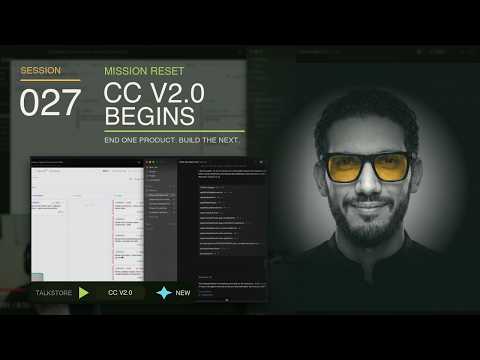
RIP. NEW MISSION. CC V2.0
Want to back the stream? The «داعم» membership on YouTube is EGP 60 a month: badges, emoji, and I answer your questions first on stream. Become a supporter
The gist
The stream centers on redesigning a largely autonomous “Command Center” that routes coding tasks by size and dependency, delegates research, exploration, and implementation to agents, and introduces task- and milestone-level audits before human review. Luqman demonstrates unfinished practical work across Codex, Claude, and terminal workflows, weighing output quality against token consumption and usage limits while encountering real friction involving Supabase, Docker, MCP, and stalled tasks; the workflow is therefore not presented as a completed success. The discussion broadens to unit testing, lightweight feature specifications, competitor research before building, and the need to market products rather than stopping after implementation. He also outlines a Shopify tool concept for measuring and improving product visibility in AI answers through GEO, which he described at the time of the 2026 recording as an emerging field and forecast to grow, particularly toward late 2026, while leaving market viability, implementation complexity, and the GEO–AEO distinction unresolved. Drawing on experience that began with dropshipping in 2017, Luqman compares dropshipping with DTC and white labeling, e-commerce with app economics, and B2B with experimental B2C directions; he also offers opinions on SaaS margins and recurring revenue, reasons for choosing the Shopify ecosystem, and app marketing through defined audiences, acquisition channels, and a mix of organic and paid approaches, without presenting these views as guarantees or settled outcomes. Secondary discussions cover automated short clips and the risk of lost context, recorded streams as a work archive and community-learning channel, programmatic marketing videos with Remotion, thumbnail experiments, and copyright constraints. Audience questions add useful discussions about learning software development through practical AI-assisted projects, verifying the security and provenance of agent skills, estimating time, managing dependencies, model pricing and compute efficiency, and scheduling work around session limits. The qualified conclusion is that automation may reduce manual coordination but does not remove the need for oversight, debugging, and validation; Luqman argues that strong planning and context matter more than minimizing token use alone.
155 moments from the stream
- 3:08:43
Evaluating the Codex UI for Web Development
Based on an early personal evaluation, the speaker highlights Codex’s ability to open a website inside the app, select a page element, and comment on it directly to send context to the agent, alongside convenient navigation and screenshots while investigating server issues. He compares it with another tool and stresses that he is still experimenting rather than giving a final verdict.
- 3:09:56
Command Center V2 Automation
The speaker explains that the new Command Center V2 is now highly automated, so it currently requires one focused session rather than the continual attention it needed before.
- 3:12:19
Finding a Design Extension and Its Interface
A troubleshooting discussion about locating and installing a design tool whose name is unclear in the captions, including whether it is a plugin, skill, or browser extension and where its interface appears in settings. Potential uses included video editing, marketing materials, and presentations, while regional availability remained unverified.
- 3:21:16
Investigating Why Dependencies Became Unblocked
After an agent adjusted some dependencies, the items in a later stage appeared fully unblocked with no visible dependencies. The passage ends by asking what caused the change, without yet providing an explanation.
- 3:25:14
Exploring a Browser Extension for Design Work
The speaker considered a suggested browser extension that might help with design, marketing, and video-editing work and installed it for exploration, while clearly stating that he had not used it before and did not yet understand how it related to design access or how it worked.
- 3:28:01
Managing AI Coding-Tool Usage Limits
The speaker described postponing nonessential questions, limiting concurrent sessions, and shifting work between coding tools when usage limits become constrained, without disclosing private account figures.
- 3:29:29
A Milestone-Auditing Agent for Cleaner Debugging
The speaker described allowing some flexibility in task dependencies unless a prerequisite or red flag requires strict ordering. He then outlined an auditing agent that reviews an entire milestone for problems before work proceeds, saying its design reflects lessons from earlier workflow mistakes and is intended to make implementation and debugging cleaner. He also said he planned to make the command center available on GitHub.
- 3:32:34
Publishing a Reusable Tool
The speaker favors making the tool public so others can use it directly, while noting that rebuilding something similar from scratch can still be a useful learning experience.
- 3:34:24
Measuring and Improving Shopify Product Visibility in AI Search
The speaker outlines a Shopify tool intended to measure how visible a store or product is in AI-generated answers through an index and targeted checks. It would inspect product pages for missing descriptions, weak metafields, poor organization, and absent or inaccurate image alt text, then suggest changes that may help AI systems understand the products. He presents this as an emerging GEO direction while acknowledging that market awareness is still developing and implementation is complex.
- 3:43:47
Milestone Auditing, Task Automation, and Dependency Limits
The speaker describes a workflow that runs a checklist-based auditor after completing one milestone and before starting the next, aiming to identify critical issues. He also explains a command that executes a batch of tasks and then triggers an automated review, with an important limitation: dependency-blocked tasks cannot all run in parallel and must advance sequentially.
- 3:47:40
Automated Short Clips and the Risk of Lost Context
The speaker describes an automated workflow that extracts shorts and reels from streams, then discusses the difficulty of compressing a complex economic topic into a brief clip. Shortening can remove qualifications, solutions, and context, allowing the message to be interpreted in unintended ways, so he sees a need to review what the automation selects.
- 3:54:05
Executing Small Tasks from the Command Center
Luqman explains a command that has the agent inspect open tasks in the command center, select small tasks, and work through them sequentially, with an emphasis on execution speed.
- 3:55:52
Estimating Project Duration from Measured Progress
Luqman outlines a rough estimate based on timing a portion of completed work and extrapolating the total duration, while cautioning that it is not precise because milestones vary in difficulty and pace.
- 3:57:23
Continuous Review to Reduce Final-Delivery Bugs
Drawing on an earlier experience, Luqman argues that an auditor and reviewer checking every task and milestone can reduce—not eliminate—diagnosis and debugging at final delivery. An audience comment suggests recording per-task time and using similar past work to improve future estimates.
- 4:00:20
Sweep vs. Prepare for Tasks of Different Complexity
Luqman contrasts a command that executes small tasks immediately with one that prepares medium tasks through research and exploration agents before building. In this run, he observes Claude following the commands and rules better than Codex, but says the preparation stage consumes many tokens and needs a more efficient design while remaining valuable.
- 4:05:43
Evaluating Task-Preparation Overhead for Coding Agents
The speaker reviews the preparation stage for a batch of small and medium tasks assigned to local agents, noting that this batch contains no large or architectural tasks. He treats the preparation as milestone-specific and monitors its general impact on usage limits.
- 4:09:30
Inspecting Prompt Generation from Researcher and Reviewer Docs
The speaker inspects the documentation view to follow task prompts produced by the researcher and reviewer stages. He observes active-task prompts appearing progressively, questions how the remaining prompts are handled, and continues monitoring the list without confirming a final outcome.
- 4:13:29
How the Command Center Evolved from a Project Map into an Agent Workflow
The speaker explains that the idea began as a project map, then developed around swimlanes and an agent-managed task board before expanding to include an agent hub, quality assurance, and a calendar. The stated goal is balanced automation that keeps the project's direction and details visible.
- 4:16:19
Typing Arabic through Franco-Arabic Transliteration
During a discussion about slow Arabic typing, the speaker mentions an iPhone keyboard that converts Arabic pronunciation typed in Latin characters directly into Arabic script. It is presented as a possible input aid, without a reliably identified keyboard name.
- 4:19:17
Improving E-commerce Visibility in AI Answers
The speaker outlines an e-commerce tool concept based on generative engine optimization (GEO), motivated by the observation that some shoppers now ask ChatGPT, Perplexity, and similar tools for product recommendations instead of relying only on Google Search. The proposed service would measure a store's visibility in AI channels, identify Shopify product-data issues, and recommend or automatically apply improvements. These are described capabilities and goals, not verified test results on this page.
Got a question about something in this stream?
Ask in the group