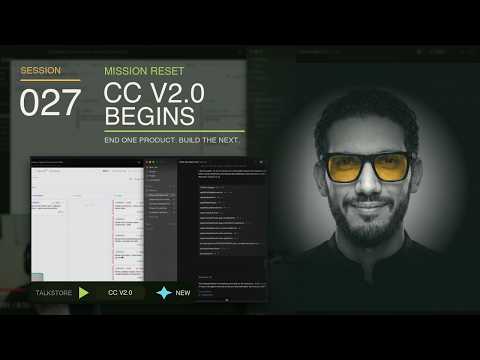
RIP. NEW MISSION. CC V2.0
Want to back the stream? The «داعم» membership on YouTube is EGP 60 a month: badges, emoji, and I answer your questions first on stream. Become a supporter
The gist
The stream centers on redesigning a largely autonomous “Command Center” that routes coding tasks by size and dependency, delegates research, exploration, and implementation to agents, and introduces task- and milestone-level audits before human review. Luqman demonstrates unfinished practical work across Codex, Claude, and terminal workflows, weighing output quality against token consumption and usage limits while encountering real friction involving Supabase, Docker, MCP, and stalled tasks; the workflow is therefore not presented as a completed success. The discussion broadens to unit testing, lightweight feature specifications, competitor research before building, and the need to market products rather than stopping after implementation. He also outlines a Shopify tool concept for measuring and improving product visibility in AI answers through GEO, which he described at the time of the 2026 recording as an emerging field and forecast to grow, particularly toward late 2026, while leaving market viability, implementation complexity, and the GEO–AEO distinction unresolved. Drawing on experience that began with dropshipping in 2017, Luqman compares dropshipping with DTC and white labeling, e-commerce with app economics, and B2B with experimental B2C directions; he also offers opinions on SaaS margins and recurring revenue, reasons for choosing the Shopify ecosystem, and app marketing through defined audiences, acquisition channels, and a mix of organic and paid approaches, without presenting these views as guarantees or settled outcomes. Secondary discussions cover automated short clips and the risk of lost context, recorded streams as a work archive and community-learning channel, programmatic marketing videos with Remotion, thumbnail experiments, and copyright constraints. Audience questions add useful discussions about learning software development through practical AI-assisted projects, verifying the security and provenance of agent skills, estimating time, managing dependencies, model pricing and compute efficiency, and scheduling work around session limits. The qualified conclusion is that automation may reduce manual coordination but does not remove the need for oversight, debugging, and validation; Luqman argues that strong planning and context matter more than minimizing token use alone.
155 moments from the stream
- 4:24:45
Choosing Apple Hardware for AI-Assisted Coding
The speaker favored Apple devices for AI-assisted coding and identified the Mac mini and Mac Studio as options worth researching. Qualifying that his hardware expertise was limited, he advised comparing specifications against the workload, current setup, and budget, with AI assisting the research before purchase.
- 4:28:13
Operating a Largely Autonomous Command Center
The speaker described a largely autonomous command-center workflow in which tasks run mostly automatically, while his involvement is generally limited to a small set of progression and audit commands followed by waiting for completion.
- 4:33:29
The Usage Cost of Multi-Agent Milestone Preparation
The speaker explains that a single milestone-preparation request may inspect many tasks and deploy explorer and researcher agents to draft tailored prompts, consuming a substantial share of usage limits. He suggests running this kind of lengthy preparation in a separate session before its output is needed.
- 4:39:25
An Autonomous Task Workflow with an Audit Gate
The discussion outlines a workflow that starts from a task list and advances newly unblocked work through a path suited to the task size. It is intended to continue autonomously, audit the results, and pause for human review when the auditor finds a problem.
- 4:41:00
A View on GEO Growth and Its E-Commerce Opportunity
Speaking in 2026, the speaker expected GEO to become a significant trend over the following months, particularly toward the end of 2026, and noted that companies were entering the field. In his assessment at the time, GEO optimization within Shopify was still early; he presented this as a forecast and potential opportunity, not a guaranteed outcome.
- 4:42:05
Considerations When Choosing the Shopify Ecosystem
The discussion gives general reasons for choosing Shopify: demand within a defined ecosystem, some support for product discovery and marketing while strong marketing remains necessary, and the value of prior domain familiarity. It also notes that a proven approach could later expand to other commerce platforms, without implying guaranteed sales.
- 4:44:07
Grouping Tasks by Dependency to Move Faster
A discussion about avoiding workflows where every change passes through many tasks, suggesting that small tasks be swept together and build-ready medium tasks be grouped instead of handled individually, while avoiding unnecessary process complexity.
- 4:45:17
When Competition Signals a Real Market
The speaker argues that competitors can be a positive signal of demand and an existing market, but that the risk changes when a free alternative delivers better work. He frames this as a lesson in researching competitors and comparing quality, pricing, and differentiation, while keeping future plans tentative.
- 4:48:25
Task Waves and the Blocked-Queue Problem
A wave is explained as a group of tasks that can run at the same time because they do not depend on one another. The discussion then clarifies that the real bottleneck is not the ready queue but a backlog of blocked tasks waiting on dependencies.
- 4:49:33
Unverified Early Impressions of a New Model Release
The speaker discusses a report of a new model release that he has not yet verified and relays that some people described it as strong, while stressing that he knows little about the model and wants a source before forming an opinion.
- 4:52:57
Testing a Prepared-Work Handoff to Codex
The speaker proposes testing a workflow in which Codex receives work material prepared by Claude, reads it, and applies the requested changes as a practical handoff between AI coding tools.
- 4:59:56
Why AI Model Releases Cluster Around the Same Dates
Luqman and the audience discussed why releases from several AI-model providers often appear close together. He relayed an unverified benchmark claim about a new model, while an audience member suggested that Chinese companies may release models shortly before a major holiday; this remained a possible explanation, not a confirmed cause.
- 5:01:57
Producing Marketing Videos with Code and AI Tools
Luqman explained that Remotion can be used with Claude to create videos—including marketing videos—through code. He also expressed interest in trying a newly mentioned tool whose name is unclear in the captions, saying it might significantly change video-editing workflows, while clearly treating that as an expectation before testing it.
- 5:05:27
Autonomous Agent Orchestration for Project Tasks
Luqman demonstrated a workflow that prepares prompts for medium-complexity tasks in a milestone and then asks Codex to process them. The system checks dependencies, moves work through progress and review states, completes it when criteria are met or creates follow-up work when needed, and repeats the loop across remaining tasks. The run began during the demonstration, but he noted that dependencies and bugs could interrupt it, so successful completion was not established.
- 5:08:42
Estimating Project Duration from Completion Rate
Luqman described a rough way to estimate total project time: measure how long a completed percentage took, then extrapolate that rate across the remaining work. He cautioned that the initial calculation may not include debugging time, so it should be treated as an estimate rather than a guaranteed schedule.
- 5:16:28
Designing an Autonomous Workflow for Dependent Tasks
Luqman explains a multi-milestone, multi-phase workflow that inspects each task’s dependencies, unblocks eligible work, and proceeds without continuous prompting. The practical uncertainty was whether the agent would begin work immediately after unblocking a task or stop, so the workflow was still being evaluated.
- 5:21:16
Does Model Hype Match Practical Results?
A brief comment acknowledges substantial hype around an anticipated model while withholding judgment until practical performance can show whether it is justified. This passage does not present a completed test or a confirmed result.
- 5:22:03
Automatic Dependency Unblocking with an Audit Gate
The experiment shows the workflow unblocking several tasks of different sizes and beginning work, while the order in which it would choose them remained uncertain. Luqman explains that an auditor agent reviews the output and can halt progress on a critical issue instead of automatically passing the work, a safeguard because autonomous sessions may still cause problems.
- 5:25:03
Debugging Difficulty and Coding-Agent Context Limits
The speaker described debugging in Cursor as especially difficult within AI-assisted coding and expressed reservations about the workflow because of the agent’s limited context window and the need to keep monitoring usage limits.
- 5:28:41
Experimenting with Stream Thumbnails While Considering Copyright
The speaker discussed making small changes to stream-thumbnail styling after reviewing reference examples, while being careful about copyright concerns, and expected the experiment to produce a result that could later be evaluated.
Got a question about something in this stream?
Ask in the group